
Anne Carson
Canadian poet and classicist Anne Carson won the 2026 Nobel Prize in Literature. How Sappho, a teacher in Port Hope and a life in classics shaped her work.
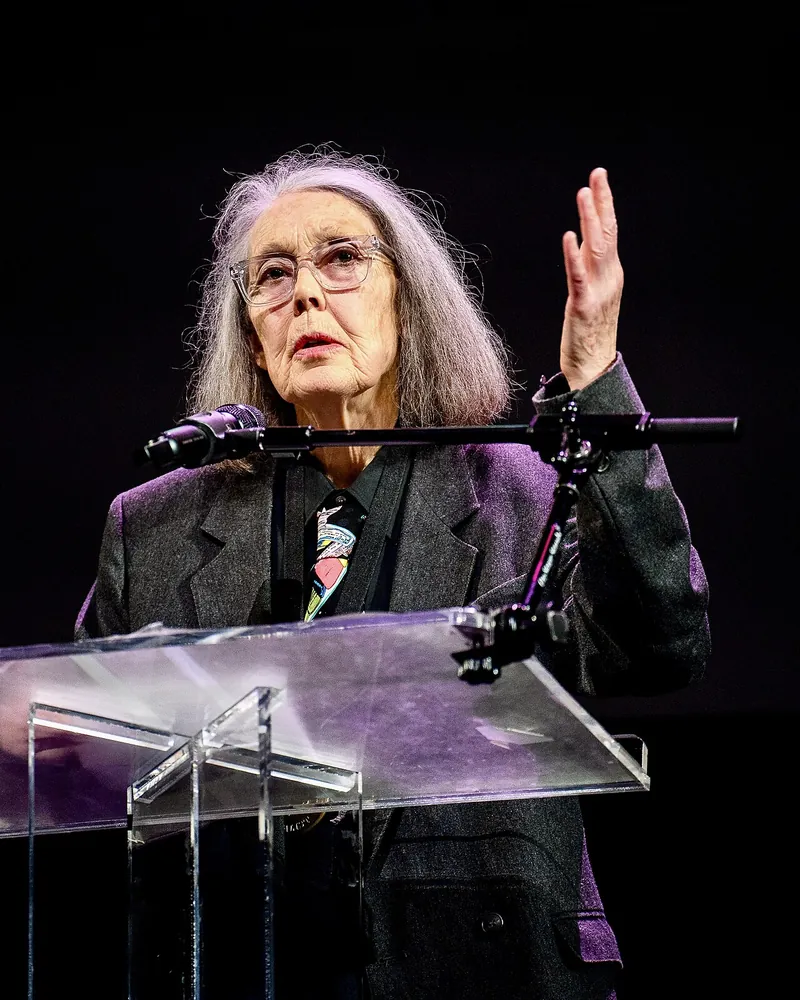
Photo: Jay Dixit, CC BY-SA 4.0, via Wikimedia Commons. Resized and converted to WebP.
A Phone Call in Iceland, 8 October 2026
When the Swedish Academy announced the 2026 Nobel Prize in Literature in Stockholm on 8 October 2026, its laureate was not at a desk waiting for the call. Anne Carson was in Iceland. Ingrid Carlberg, the Academy's permanent secretary, said Carson "was very taken by surprise" and that in their short conversation she had time to say only that she was "listening to the wind." Speaking to the Icelandic broadcaster RUV shortly after the announcement, Carson said: "Crazy. I think they're all crazy."
The prize went to her alone, "for her bold and inventive oeuvre that, in playful dialogue with the classical tradition, has created new forms for contemporary literature." It is worth 12 million Swedish crowns, and the award ceremony is set for 10 December 2026. Carson, 76, divides her time between Iceland and Ann Arbor, Michigan, and holds both Canadian and Icelandic citizenship. She is the third Canadian-born winner of the literature prize, after Saul Bellow in 1976 and Alice Munro in 2013.
Prime Minister Mark Carney wrote that she "has reimagined the classics" and "brought ancient stories to new audiences." Melanie Woodin, president of the University of Toronto, where Carson earned all three of her degrees, called it "a very proud moment for our global alumni community and for the entire university."
Bank Towns in Ontario and Mrs. Cowan's Lunch Hour
Carson was born in Toronto on 21 June 1950, the second and last child of Margaret and Robert Carson. Her mother kept house. Her father worked for the Toronto Dominion Bank, and the family moved with his postings through small Ontario towns: Stoney Creek, Port Hope, Timmins.
Port Hope is where the classics found her. In a 2004 interview with the Paris Review, Carson said her high school Latin teacher, a Mrs. Cowan, also knew Greek and offered to teach it to her once she learned the student was curious. "We did it on our lunch hour," Carson said. She was in grade thirteen, and when asked whether it was immediately clear the lessons would change her life, she answered, "Yes, immediately."
The family stayed in Port Hope for six or seven years, and her parents for about fifteen. Decades later she told the same interviewer that she still dreaded passing the town on the train to Toronto.
Three Degrees at the University of Toronto
Carson studied classics at the University of Toronto, where she attended St. Michael's College and left the program twice before finishing. She took her BA in 1974 and her MA in 1975. In between, she spent a year at the University of St Andrews in Scotland studying Greek metrics, working with the classical scholar Kenneth Dover, according to the Paris Review. She completed her PhD at Toronto in 1981.
Her dissertation was on Sappho. It became her first book, Eros the Bittersweet: An Essay, published by Princeton University Press in 1986, which the Paris Review described as a brief, dense treatise. She had already started teaching: the Academy of American Poets dates her years at Princeton to 1980 through 1987.
Short Talks and the Drawings Nobody Liked
Publishers were slow to take her poems. Carson was 42 when a small Canadian press, Brick Books, brought out her first poetry collection, Short Talks, in 1992. The book began as drawings. Carson made pictures and gave them titles, and the titles grew into the prose poems. "No one ever liked my drawings," she told the Paris Review. "It's scarier to draw. It's more revealing. You can't disguise yourself in drawing."
She has kept that idea of a poem as something seen as well as read. "Making a poem is making an object," she told Eleanor Wachtel on CBC's Writers & Company. "I always thought of them more as drawings than as texts, but drawings that are also physically enterable through the fact of language."
By the mid-1990s the position had reversed and publishers were coming to her. The Academy singled out two books from that decade. Of Glass, Irony and God, it wrote that the book "demonstrates the potential of the long poem where genre boundaries are seen to blur." Autobiography of Red: A Novel in Verse, published by Knopf in 1998, reworks the ancient Greek poem Geryoneis, with the monster Geryon falling in love with Heracles; the Academy cited it for "her eminent ability to actualize the classical literary tradition."
Sappho, Euripides and An Oresteia
Translation runs alongside the poetry rather than behind it. If Not, Winter: Fragments of Sappho (2002) translated the surviving lines of the poet she first read on her lunch hour. Grief Lessons: Four Plays (2006) translated Euripides, and An Oresteia (2009) joined plays by Aeschylus, Sophocles and Euripides into a single cycle. As the Anna-Maria Kellen Fellow at the American Academy in Berlin in the fall of 2007, she began a translation of Prometheus Bound.
Some of the translations became performances. In May 2015 she performed her work Antigonick at the Moderna Museet in Stockholm. She has also written texts adapted for opera and recorded spoken word tracks for The Great Lakes Suite, an album by the Toronto band Rheostatics.
The Academy's statement traced all of it to one habit: "Almost all her literary production has centred upon the intersection between the philologist's obsession with words and the poet's desire for new meaning." Carson, it added, "has herself identified the etymology of words as the starting point for all her work."
Nox, a Book for Her Brother Michael
When her brother Michael died suddenly in another country, Carson had not seen him for twenty-two years. "He was a mystery to me," she told the Paris Review. "I had a need to gather up the shards of his story and make it into something containable." The book she made for him, published as Nox in 2010, starts from a poem by Catullus, the Roman poet who traveled to Troy to bury his own brother. Carson took the Latin apart one word per page, setting each word and its dictionary definition on the left and a fragment of memory about her brother on the right.
Red Doc> followed in 2013 and Float in 2016, both from Knopf. Wrong Norma (New Directions, 2024) was a finalist for the National Book Award and won the National Book Critics Circle Award, according to the Academy of American Poets.
Princeton, McGill and Ann Arbor
Carson has spent her working life as a professor of classics as well as a writer. Besides Princeton, she has taught at McGill, Emory, Stanford, New York University, the University of Calgary, the University of California, Berkeley and California College of the Arts. At the University of Michigan in Ann Arbor she has held appointments in classics, comparative literature and English.
The prizes came steadily before the Nobel. The Paris Review lists a Guggenheim Fellowship in 1995, a Lannan Award in 1996 and a Pushcart Prize in 1997. The MacArthur Foundation named her a fellow in 2000. The Beauty of the Husband: A Fictional Essay in 29 Tangos won the T. S. Eliot Prize in 2002, making her the first woman to receive it. In 2020 she received the Princess of Asturias Award for Literature, whose jury wrote that she had "attained levels of intensity and intellectual standing that place her among the most outstanding of present-day writers," and the Governor General's Award for poetry for Norma Jeane Baker of Troy.
In an essay in the London Review of Books in 2024, Carson wrote that she had been diagnosed with Parkinson's disease. Two years later she became the third Canadian-born Nobel laureate in literature, for a body of work that began with Greek lessons in a high school classroom in Port Hope.
Sources
- Nobel Prize in Literature 2026 - Press release - NobelPrize.org
- Nobel Prize in Literature 2026 - NobelPrize.org
- Anne Carson - Facts - 2026 - NobelPrize.org
- Canadian Anne Carson wins 2026 Nobel Prize in Literature | Arts and Culture News | Al Jazeera
- Canadian Anne Carson awarded Nobel Prize in Literature | CBC News
- Paris Review - Anne Carson, The Art of Poetry No. 88
- About Anne Carson | Academy of American Poets
- Anne Carson | The Poetry Foundation
- Anne Carson - MacArthur Foundation
- Anne Carson - American Academy in Berlin
- Anne Carson - Fundación Princesa de Asturias
Filed Under Topics
Related Life Stories & Dossiers
Further inspiring trajectories within Art & Literature and influential circles.
 Art & Literature
Andrew Davies
Andrew Davies was a teacher until he was 50, then wrote House of Cards, Pride and Prejudice and Bleak House for the BBC. His career, from the sources.