
Peter Hitchens
Peter Hitchens, born in Malta in 1951, went from Trotskyist student to Moscow correspondent to Mail on Sunday columnist and won the 2010 Orwell Prize.
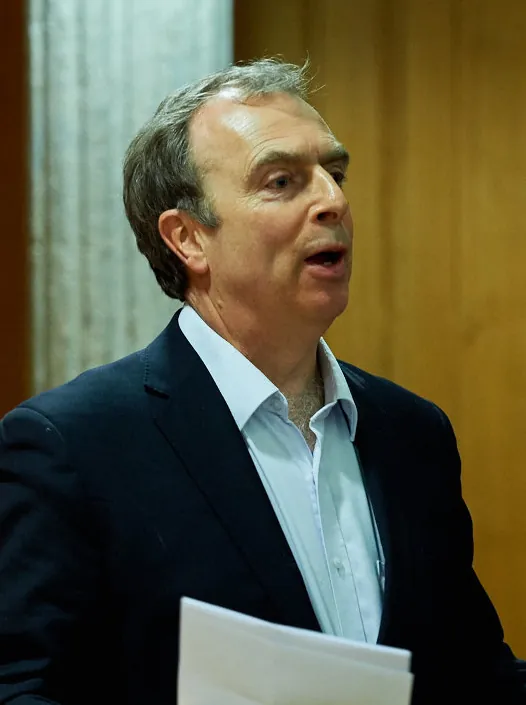
Photo: Nigel Luckhurst, CC BY-SA 4.0, via Wikimedia Commons. Resized and converted to WebP.
A Naval Posting in Malta
Peter Hitchens was born in Malta in 1951, while the island was still the main British naval base in the Mediterranean. The Library of Congress files him as "Hitchens, Peter, 1951-". His father was a career Royal Navy officer stationed there. "I was actually born in the empire," he told Brian Lamb on C-SPAN's Booknotes, and he described growing up in naval towns such as Portsmouth and Plymouth, "full of great gray warships and very serious people."
He meant to follow his father, Commander Eric Hitchens, into the Navy until an eye defect ruled it out, he told the journalist Nigel Farndale in 1999. His schooling moved with the family: a prep school in Devon, then schools in Chichester, Cambridge and Oxford. At one of them he was arrested for breaking into a government fall-out shelter, which led to what he called "a terrible scene" with the school and his parents. He finished at the Oxford College of Further Education and, by his own account, made sure he would never get into Oxbridge.
Selling Socialist Worker at the Docks
He went to the University of York instead, studying Philosophy and Politics and graduating in 1973, according to his Socrates in the City biography. His politics there were revolutionary. "I read Trotsky at university," he told Farndale. "I spent most of my time going up to Scarborough to run a cell of Trotskyite workers in a coach station, that and selling the Socialist Worker at the docks."
It was also at York that he met Eve Ross, a fellow Trotskyist student. Speaking to York Vision in 2013, he said the university had once been small enough to feel like "a village" and that he disliked how large it had become.
Swindon and the Daily Express Newsroom
His first proper job after York was on the Swindon Evening Advertiser. By Farndale's account he joined the Daily Express in 1977, and he stayed there for more than two decades, first as a reporter and later as a columnist. As an industrial reporter he kept away from the left-leaning consensus of the Industrial Correspondents' Group and cultivated the right wing of the Engineering Union instead. "People called me bonkers," he said.
The couple's break with socialism had a specific trigger, as Eve Ross Hitchens told it: an IRA supporter at a Labour Party meeting threatened to push her husband's teeth down his throat.
Poland in 1980 and the Moscow Posting
His first foreign assignment was Poland during the Solidarity crisis of 1980, and through the 1980s he reported mainly from Communist eastern Europe. He also travelled with the press group accompanying Margaret Thatcher to the United States, Japan and South Korea.
The Express then made him its Moscow correspondent. He told C-SPAN he spent two and a half years in the Soviet Union; Socrates in the City puts it at nearly three years, covering the collapse of the Soviet state. The posting changed more than his news file. That organisation's biography says he credits his return to faith largely to seeing socialism in practice there. When Farndale visited his Oxford home in 1999, a framed Solidarity poster hung on the sitting-room wall beside a case of old East European banknotes and press passes from the Reagan-Gorbachev summits.
Two Years in Washington
From Moscow he went to Washington as the Express correspondent there, part of roughly five years abroad in the two posts. He called them "two very intense years which I still look back on with enormous affection," and said living in the Soviet Union and then America made the faults of his own country clearer to him.
The Abolition of Britain, Summer 1999
Back in London as a commentator, he published The Abolition of Britain in the summer of 1999. The book sets two state occasions side by side: the funeral of Winston Churchill in 1965 and the public mourning for Princess Diana in 1997. Hitchens argued that the gap between them measured a cultural revolution. On Booknotes he said the country had been transformed "over the past 30 and 40 years." At the time he was also presenting a twice-weekly programme on Talk Radio.
Farndale found him more relaxed than his columns suggested, and asked whether he played up his anger. "Yes of course," Hitchens said. "But it doesn't mean you are being phoney."
Leaving the Express for the Mail on Sunday
In 2000 Richard Desmond, whom Farndale's later note on the interview calls a pornographer, bought the Express group. Hitchens resigned in protest, that note records, and moved to the Mail on Sunday. He has written a weekly column there ever since, along with foreign reporting. York Vision described him in 2013 as a columnist for the paper, and the Socrates in the City biography calls him a columnist and occasional foreign correspondent.
The Orwell Prize, May 2010
On 19 May 2010 the Orwell Prize gave its Journalism Prize to Hitchens for his foreign correspondence in the Mail on Sunday. It was his third shortlisting in four years. The winning entry included reports from Prague, South Africa, Tokyo, Ottawa and China, and a counterfactual piece titled "What if the Berlin Wall didn't fall?" The judges, Roger Graef and Peter Kellner, quoted Orwell's essay on Dickens, which describes a writer who "fights in the open and is not frightened" and who is "generously angry."
The Rage Against God and Christopher
His elder brother Christopher, born two and a half years earlier, was a militant atheist whom Farndale called probably the most famous British journalist working in America. On Booknotes in 2000, Peter called himself a member of the Anglican Church. Farndale put the brothers' main dispute down to religion, and Peter agreed: "Everything else flows from that."
He set out his own route back to belief in The Rage Against God. A 2011 review in The Banner summarised it: as a young man he burned his Bible, became a Trotskyist, and then saw in Moscow an atheist state that had tried to destroy Christianity. "If it hadn't been for the loss of the Trotskyite system of belief, my religious faith might not have come so quickly," he had told Farndale a decade earlier. The brothers debated the invasion of Iraq and the existence of God in the United States in 2008, and the place of God in civilisation at the Pew Forum in 2010.
His other books include The War We Never Fought, an attack on British drug policy. On Channel 4 he wrote and presented critical documentaries about Nelson Mandela and David Cameron.
A House in Suburban Oxford
Hitchens and Eve Ross lived together before they married in 1983. She kept her maiden name as a middle name. They moved to a suburb of Oxford when their first child was born, and she gave up her work as a solicitor. They have three children. In 2000 he told C-SPAN that they were 17, 11 and 18 months old, and that his children "always laugh at you, and mine are no exception."
His views on schooling stayed as fixed as his views on faith. He told York Vision in 2013 that he would return to a system in which students had their fees paid and received a maintenance grant, with "many many fewer people" going to university.
Sources
- August 1999 - Nigel Farndale
- Booknotes :: Home
- Peter Hitchens | Socrates in the City
- Orwell Prize 2010 winners announced | The Orwell Foundation
- An Interview with Peter Hitchens | York Vision
- The Rage Against God: How Atheism Led Me to Faith | The Banner
- Search - LC Linked Data Service: Authorities and Vocabularies | Library of Congress
Filed Under Topics
Related Life Stories & Dossiers
Further inspiring trajectories within Art & Literature and influential circles.
 Art & Literature
Dale Brown
Dale Brown, the Buffalo-born former Air Force captain who created Patrick McLanahan, on his B-52 years, Flight of the Old Dog, and his later series.
Bruce Bawer
Bruce Bawer, a New York-born critic and author living in Norway, moved from poetry criticism to gay rights, Christianity and Islam in Europe.
 Art & Literature
Laurie Halse Anderson
Laurie Halse Anderson, author of Speak and Chains, on her path from a Methodist parsonage to the Astrid Lindgren award and the fights over her books.