
Andrew Davies
Andrew Davies was a teacher until he was 50, then wrote House of Cards, Pride and Prejudice and Bleak House for the BBC. His career, from the sources.
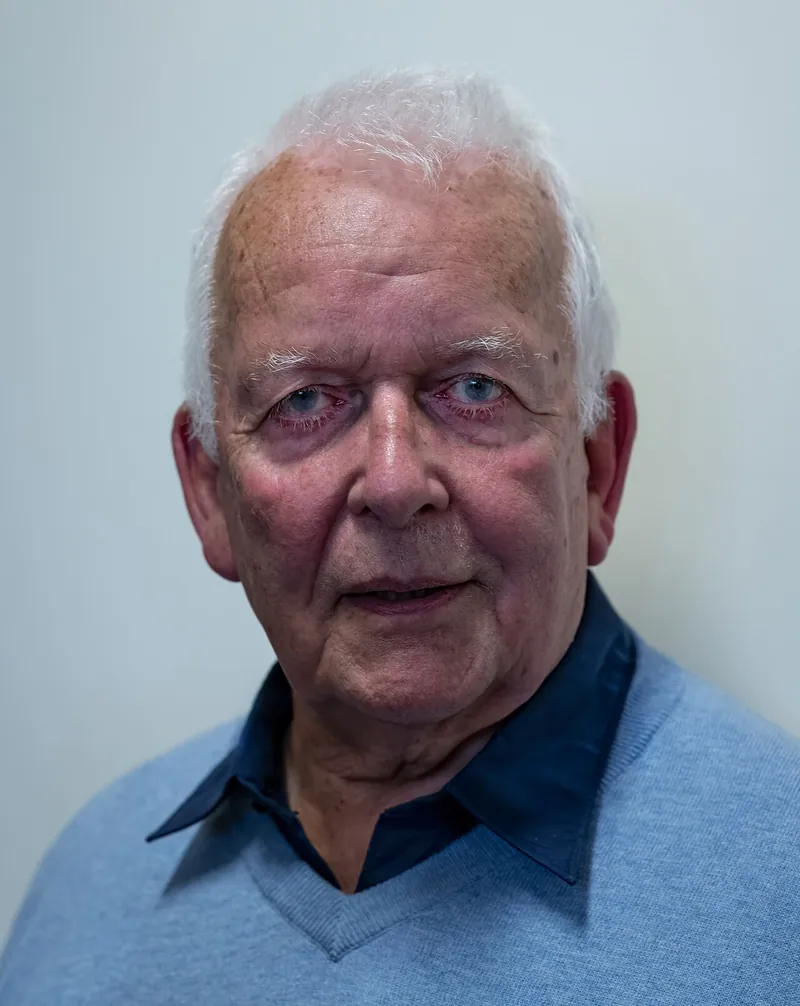
Photo: Karen Tillett, CC BY 2.0, via Wikimedia Commons. Resized and converted to WebP.
Cardiff, University College London and a Cancelled Radio Play
Davies was born in Cardiff on 20 September 1936 and brought up in Wales. Both of his parents were teachers. His early ambition, he told one newspaper, was to follow Dylan Thomas: to "go to London, get drunk a lot and have loose women". He started with radio plays because Thomas had written Under Milk Wood for radio. When he was 21 his father told him that if he had no novel published by the age of 30 he "might as well pack it in".
He graduated from University College London in 1957 with a degree in English and went into teaching, first in schools and later in universities. His first radio play, in 1964, drew on his teaching days in Wales. The producer decided to record it on location at the school. The headteacher recognised himself in the script and threatened to sue, and the play was pulled. Davies told the Guardian in 2016 that his writing career began with an announcer reading out what would be heard in place of the advertised programme.
Television came slowly. Who's Going To Take Me On? went out in the BBC's Wednesday Play strand on 8 February 1967, but he did not sell full-length work consistently until the 1970s.
The University of Warwick and A Very Peculiar Practice
In the 1960s Davies and Diana Huntley both worked at a teacher training college in Coventry, and he has lived in the same Warwickshire house ever since. He moved on to the University of Warwick and wrote around his teaching. The 1970s scripts include Is That Your Body, Boy? (1970), about a disciplinarian PE teacher, a version of Dickens's ghost story The Signalman (1976), and a serial about Karl Marx's youngest daughter, Eleanor Marx (1977). The thirteen-part To Serve Them All My Days, from R.F. Delderfield's novel, followed in 1980-81.
He wrote for children as well. Conrad's War won the Guardian Children's Fiction Prize in 1979, and Educating Marmalade ran on ITV from 1982 to 1984.
The plays stayed close to home. Bavarian Night, a Play for Today from 1981, was based on parents' evenings at his children's school, to which Davies added Nazi salutes and adultery in the infant cloakroom. A video of it went round the staff and parents for years. He recalls the head's verdict: "This play isn't about our school at all. It's about Davies's diseased imagination."
A Very Peculiar Practice ran on the BBC from 1986 to 1988, with Peter Davison in the cast. Screenonline describes a satire packed with one-liners and set in "an all-too-plausible catalogue of Higher Education mismanagement". Thirty years later the Guardian called it prophetic about the privatisation of an English university. Davies left teaching in 1987.
Francis Urquhart and House of Cards
House of Cards (BBC, 1990) came from a political thriller by Michael Dobbs. Its lead, Francis Urquhart, is a plotter for the years after Thatcher. Screenonline's judgment is that across the serial and its sequels, To Play the King (1993) and The Final Cut (1995), Davies gained more influence over the material than the novelist did, and that Dobbs's later books partly reflect it.
The best-known line, "You might very well think that; I couldn't possibly comment", has been credited to Dobbs. Davies told the Guardian he steeled himself to go through the novel and check. "I was pleased to discover that line wasn't Dobbs, it was me," he said, adding that Dobbs had "created an absolutely cracking plot".
The serial was shown in the United States on PBS's Masterpiece Theatre. In 1991 it won Davies the Primetime Emmy for Outstanding Writing in a Miniseries or a Special.
Middlemarch, Then the Pemberley Lake
BBC Drama in the 1990s preferred modern pieces to the costume drama Davies wanted to write. Screenonline records that he was steered away from Jane Austen towards George Eliot's Middlemarch (1994), and that its success brought the commission for Pride and Prejudice (1995).
The scene everyone remembers is not in the novel. "The idea was that Darcy would jump stark naked into the lake, as chaps did back then," Davies said at the Guardian Hay Festival in 2003. Colin Firth vetoed that and kept his shirt and trousers on. The Guardian's report of the talk called the result one of the most unforgettable moments in British television history. Davies also made Firth dye his hair. Shortly before, Firth had appeared in Circle of Friends, a film Davies wrote, and his hair in it was, Davies says, "gingerish".
The American broadcast on A&E brought an Emmy nomination for the screenplay in 1996. At Hay, Davies said Austen was the only writer he had adapted for whom he felt "awe and reverence".
Bleak House in Half-Hour Episodes
The adaptations that followed include Moll Flanders (ITV, 1996), Vanity Fair (1998), The Way We Live Now (2001), Daniel Deronda (2002), Doctor Zhivago (ITV, 2002) and Tipping the Velvet (2002). In cinema he has a screenplay credit on Bridget Jones's Diary (2001), and by June 2003 he had finished a script for its sequel. He shared the credit on the 2008 film of Brideshead Revisited with Jeremy Brock, who told the Independent how "unreverent" Davies is of a novel's standing, and called him "unafraid".
Bleak House went out on BBC One in autumn 2005 in half-hour episodes, shown twice a week. Davies was hesitant when Jane Tranter, the BBC's head of drama, suggested the book, because Arthur Hopcraft's earlier adaptation was still vivid to him. He gave the credit for the format to his producer, Nigel Stafford-Clark. As he told Robert Giddings, a media professor at Bournemouth University, "it was brilliant Nigel who came up with the idea of adapting it in a large number of half-hour episodes". In a PBS press interview he was blunt about the novel: "plot-wise it's a nightmare, because it is so convoluted and keeps spinning off into sub-plots". Quite a bit of the plot, he said, "doesn't work, so you have to straighten things out".
Screenonline calls the result "a hugely successful period soap". The screenplay was nominated for an Emmy in 2006 and did not win. Little Dorrit (2008) did: it brought Davies his second writing Emmy in 2009. Stafford-Clark, who produced two Trollopes and a Dickens with him, told the Independent that Davies "moves very serenely across the surface like a swan", and that "like a swan, he is paddling hard".
The Netflix Contract and a Lecturer's Lifestyle
The American House of Cards was made for Netflix by Donen/Fincher/Roth and Trigger Street Productions in association with Media Rights Capital. Davies and Dobbs are both listed as executive producers, and the Television Academy records five Outstanding Drama Series nominations for Davies in that role between 2013 and 2017, none of them a win. He is plain about what the credit involves. "I haven't done a thing on it. I just get paid for allowing them to plunder my work on the British version. And for me not ever to say anything bad about their show. That's in the contract."
A writer starting now would be pushed to form a company and run his own shows. Asked whether he regretted missing that, Davies said: "Not really. I've never been keen to have lots of money. Having more than I need is brilliant, but we more or less lead the lifestyle of retired university lecturers." He tried the showrunner role once, on Mr Selfridge: "I couldn't control my team, couldn't get a word in." None of the sources behind this article puts a figure on his wealth, so it gives none.
The sources do not agree on his prizes either. The Guardian in November 2016 counted five Baftas and two Emmys. The Independent, in February of the same year, counted three Baftas. The Television Academy's own record shows nine Emmy nominations and two wins.
At 80, with War and Peace (2016) behind him, he was adapting Victor Hugo's Les Misérables with the same team and expecting trouble from people who knew only the musical: "people will say, 'Where are the songs?'" His preparation had not changed. He drives around Warwickshire listening to the audiobook to get the shape of a novel into his head, and he cut his copy of War and Peace into manageable chunks with a carving knife. The projects he still wanted were John Updike's Rabbit books and a mash-up of Alison Lurie's campus novels.
Sources
- BFI Screenonline: Davies, Andrew (1936-) Biography
- Andrew Davies: 'I can't control myself'
- Andrew Davies, profile: Undisputed tsar of sexed-up classics behind 'War and Peace'
- Universally acknowledged hunk vetoed nude scene
- Guardian children's fiction prize relaunched
- Andrew Davies | Emmy Awards and Nominations | Television Academy
- Robert Giddings Reviews Andrew Davies-BBC-1-Bleak House
- Andrew Davies Interview: Getting His House In Order
Filed Under Topics
Related Life Stories & Dossiers
Further inspiring trajectories within Art & Literature and influential circles.
 Art & Literature
Anne Carson
Canadian poet and classicist Anne Carson won the 2026 Nobel Prize in Literature. How Sappho, a teacher in Port Hope and a life in classics shaped her work.