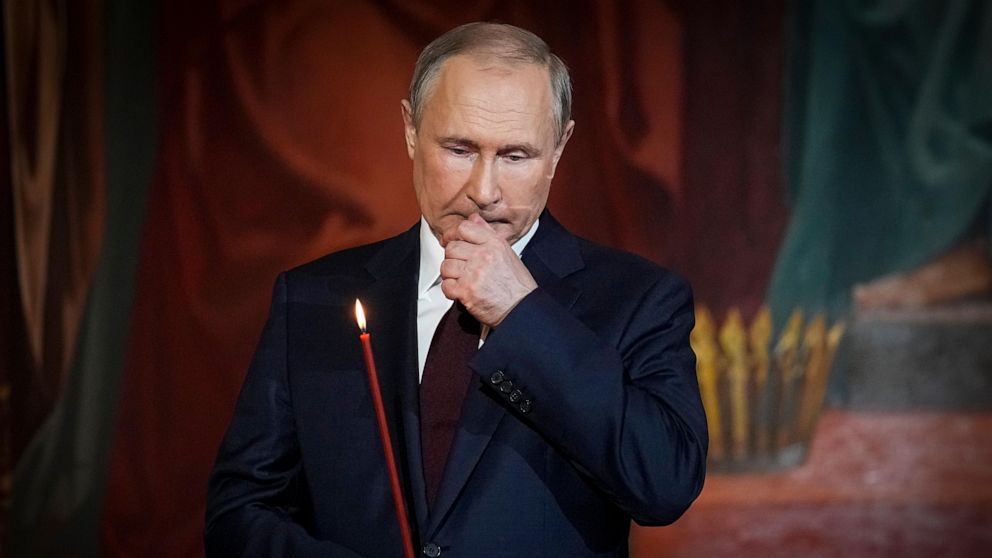

Vladimir Putin says he learned from his childhood fights in his native St. Petersburg: “If you want to win a fight, you have to fight it to the end, as if it were the most decisive battle of your life.
This lesson, quoted in the Russian president’s most recent biography, seems to guide him as his invasion of Ukraine suffers setbacks and stalemates. The Kremlin strongman, who started the war on February 24, 2022 and could end it in a minute, seems determined to win, ruthlessly and at all costs.
Enthusing his compatriots this month on the 80th anniversary of the Battle of Stalingrad which upended Moscow’s fortunes in World War II, he said: “The will to go beyond for the good of the homeland and truth, to do the impossible, has always been and remains in the blood, in the character of our multi-ethnic people.
But so far, Putin’s gamble to invade his smaller, weaker neighbor appears to have backfired dramatically and created the biggest threat to his more than two-decade rule.
HISTORY AND MODERN OBSTACLES
He launched the “special military operation” in the name of demilitarization and “denazification” of Ukraine, seeking to protect ethnic Russians, prevent Kiev from joining NATO and keep it in Russia’s “sphere of influence”. While he claims that Ukraine and the West provoked the invasion, they are saying the exact opposite – that it was an illegal and brazen act of aggression against a country with a democratically elected government and a Jewish president whose relatives were killed in the Holocaust.
Putin laid the groundwork for the invasion with a 5,000-word essay in 2021 in which he questioned Ukraine’s legitimacy as a nation. It was just the latest chapter in a long obsession with the country and a determination to correct what it sees as a historic mistake of letting it slip out of Moscow’s orbit. It goes back three centuries, to Peter the Great, to support his quest to reconquer legitimate Russian territory.
But the rectification of history quickly ran into modern roadblocks.
“Literally everything he did went wrong,” said British journalist Philip Short, who published his biography, “Putin,” last year.
Despite armed interventions in Chechnya, Syria and Georgia, Putin overestimated his military and underestimated Ukrainian resistance and Western support. Russian media try to bolster his authority with images of a shirtless Putin on horseback, firing at a military firing range and disguising government officials on television, but the war has exposed his shortcomings and the weakness of his army, intelligence services and certain economic sectors.
Ukrainian forces have liberated more than half of the territory seized by Russia. The war has killed tens of thousands of people on both sides, caused massive destruction and prompted not only Ukraine, but also Sweden and Finland to seek NATO membership. It has increased the security threat to Russia and scuttled decades of Russian integration with the West, resulting in international isolation.
Increasingly, Putin seems to be improvising in a much longer and more difficult conflict than he had anticipated. For example, he threatened to use nuclear weapons, then backed down. The strategy is familiar to his lifelong passion, judo: “You have to be flexible. Sometimes you can give way to others if that’s the way to victory,” Putin recounted in flattering 2015-2017 interviews with American director Oliver Stone.
For Putin, an aggressive West wants to crush Russia. His story, along with increasingly repressive measures to stifle national dissent, galvanized the patriotic support of many of his compatriots. But it comes up against an ineffective, top-down power structure inherited from the Soviet Union, the porous borders of the interconnected world, and the sacrifices Russians experience firsthand.
AN ERRATIC BUT DETERMINED LEADER
In interviews with The Associated Press, Short, other analysts and a former Kremlin insider describe Putin, 70, as an erratic and weakened leader, rigid and outdated in his thinking, who goes too far and denies the difficulties.
They say he appears concerned about the declining, albeit still strong, national public opinion – albeit according to unreliable polls. Mainly isolated due to concerns over COVID-19 and his personal safety, Putin speaks to a small group of advisers, but they seem reluctant to provide honest assessments.
Observers see a long and bitter war that Putin is determined to win, with an outcome difficult to predict.
“Putin is not running Russia. Circumstances rule Putin,” said Tatiana Stanovaya, senior researcher at the Carnegie Endowment for International Peace.
Short thinks the Kremlin leader “painted himself into a corner. … He’ll be looking for ways to move on, but I don’t think he’s found them.” Giving up is unlikely, Short said, recalling that “his character always had to double down and fight harder.”
Fiona Hill, who has served in the last three US administrations and is a senior fellow at the Brookings Institution, thinks Putin wanted to win Ukraine quickly, install a new president in Kiev and force it to join Belarus in a Slavic union with Russia. . A successor would lead Russia, she said, with Putin rising to lead the wider alliance.
But now, according to Stanovaya, “there seems to be no hope that the conflict can be resolved other than militarily. And that is scary.
WHAT’S AHEAD
Analysts see several scenarios for Putin, depending on how the battlefield develops. The scenarios, which are not mutually exclusive, range from what could be his biggest nightmare – a coup or uprisings like those he saw as a KGB agent in East Germany in 1989, in the USSR in 1991 or in Ukraine in 2004 and 2014 – to re-election victory next year. It would extend what is already the longest reign of a Kremlin leader since Josef Stalin.
Dmitry Oreshkin, a political analyst and professor at the Free University of Riga, Latvia, said Putin could revise his goals in Ukraine, saying he had achieved them by establishing a land corridor from Russia to Crimea and taking control of Donetsk and Lugansk regions in the east. Then he could announce, “We punished them. We showed them who’s the boss of the house. We have defeated all NATO countries,” Oreshkin added.
But kyiv has shown no willingness to cede territory, and for Putin to sell this as a victory, Orsehkin thinks “he has to convince himself that he has defeated Ukraine. And he understands better than anyone that he actually lost.
As military setbacks pile up, Russians morally and psychologically withdraw and think, “Yes, we see that something is wrong in the war, but we don’t want to know,” according to Oreshkin.
Such a stall, along with economic hardship, could backfire on Putin, he said, possibly this spring, as Russians ask, “You promised victory, so where is it?”
Putin’s former speechwriter Abbas Gallyamov said the Russian president does not admit mistakes or defeats and “desperately needs a victory just to prove he is a strong man”.
Even some servicemen are becoming critical, he said.
“When it is hated by more than half – and we are moving in that direction – the chances of a coup, an elite coup, a military coup will increase,” Gallyamov said, giving a timeline of 2024 “plus a few years.”
Stanovaya and Short think no uprising is imminent.
“Even if people are hurting, and they may be upset and angry, there’s no way to make it political,” Stanovaya said.
Gallyamov sees a way out for Putin if he can secure recognition of “new territories, plus a declaration from NATO that it stops expansion, for example, or the Ukrainian introduction into their constitution of their neutral status. .or their declaration that Russian will be the second official language.
DEATH OR SUCCESSION
Another possibility is that Putin dies in office, but CIA Director William Burns is skeptical.
“There are a lot of rumors about President Putin’s health, and as far as we can tell, he’s too healthy,” Burns, a former US ambassador to Moscow, told the Aspen Security Forum in Colorado in July. .
Short said Putin has such tight security checks and rival power centers in place that he is more likely to suffer “a totally unplanned heart attack than to be knocked down by the people around him.”
He and Hill believe Putin will eventually look for a successor. Gallyamov lists “technocrats” such as Moscow Mayor Sergei Sobyanin and Prime Minister Mikhail Mishustin as possibilities. Hill said Dmitry Medvedev, whom Putin chose as president from 2008 to 2012, “seems to be auditioning for the role again.”
For now, Putin remains very much in control. In his 2000 authorized biography, he noted: “There are always many mistakes made in war. … We must adopt a pragmatic attitude. And you have to keep thinking about winning.
When a reporter asked him in December if his “special military operation” in Ukraine had lasted too long, Putin replied with a Russian idiom about big goals gradually being achieved: “The hen pecks grain by grain.”
___
Follow AP’s coverage of the war in Ukraine at https://apnews.com/hub/russia-ukraine
ABC News
Don’t miss interesting posts on Famousbio