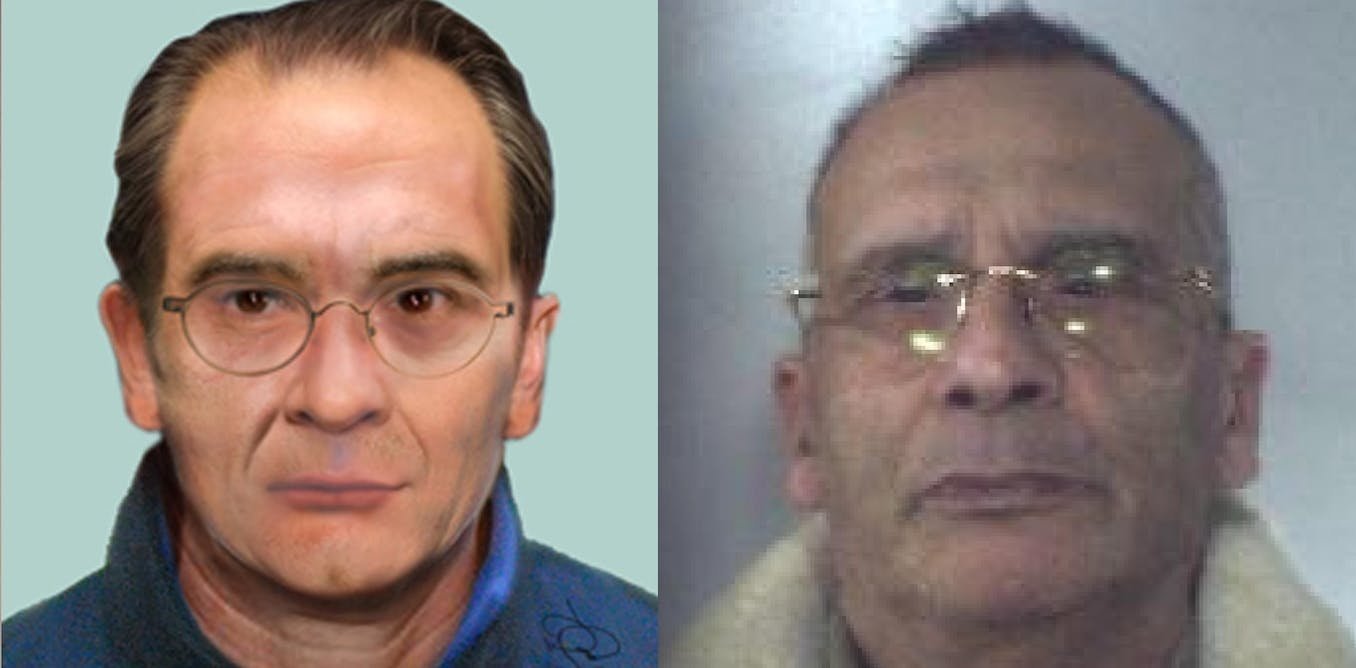


Italian police recently arrested Matteo Messina Denaro, the suspected leader of the Sicilian Mafia who has been on the run since 1993. To make the search easier, the Carabinieri have released an aged image to show what he might look like now.
Artists have traditionally created these images by altering old photos of the suspect — adding wrinkles, hair loss, and other common aspects of aging. However, in recent years there has been a trend towards using computer systems that employ machine learning, a much more sophisticated and formalized method of changing people’s faces.
We cannot predict with certainty what a person will look like years after their last available photograph, but these images can still help police. This is how technology evolved.
An evolving ability
The first computer-aided method, now obsolete, used the difference between two average images. Photos of multiple people (perhaps 30) who matched the target in terms of age, gender and general skin color were combined to create an average “young” image.
Another older set produced the average “older” face. The computer calculated the difference between the two images – gray hair, wrinkles and other features – and applied that difference to the image of the young face, resulting in one that looked older.
Whether it actually looked like the subject as an older person is another question, but when one of us (Peter Hancock) tried it it produced an image that looked a lot like his father, only without the NHS glasses.
The renowned US psychologist Alice O’Toole from the University of Texas in Dallas accidentally discovered another aspect of computerized aging. She attempted to create automatic caricatures of people in 3D, highlighting any differences between an individual face and an average of the faces of other people of the same age. She thought the cartoons looked older.
It seems that as people age, they tend to become more prominent—thin people get gaunt and big noses get bigger. This underscores an important aspect of aging – we all do it differently.
Two things affect how we age: our genetics and our environment. Working outdoors can age the skin. Smoking and diet can also have powerful effects. An artist trying to create an aged image can refer to pictures of relatives to see how age has affected them. Some computer-aided methods also attempt this.
The influence of nature and upbringing can make it difficult to predict exactly what someone will look like in the future. Our research with US psychologists Jim Lampinen of the University of Arkansas and Blake Erickson of Texas A&M University-San Antonio shows that there are major differences in how artists prepare for age progression.
We found that the average age progression from different artists was as good as the best frame. Since it is not known in advance which will be the best image, this seems like a good way to improve accuracy.
A promising alternative could be to take several different pictures of a person with some possible aging methods. For example, it could show them with varying degrees of hair loss.
The idea is based on the way facial composite images of a suspect are created. These compositions are computerized similarities based on eyewitness accounts. This is in the hope that someone can give the face to the police to provide a lead (which may or may not be accurate) to an investigation.
Software packages such as E-Fit and EvoFit (which we developed) can generate different versions of the offender’s image with and without a beard, wearing a hat and other common disguises. They also have the ability to change age, weight, health, and other age-related aspects of appearance.
New ways forward
Current computerized systems for aging suspects, based on old photos, employ deep neural networks, the kind that are changing the field of artificial intelligence. These are advanced computer systems that can be used for complex tasks and include the ability to improve by learning from examples.
The networks are trained or shown in pairs with a wide range of images showing the same person at two different ages, and then learn to do the mapping – producing an older image when given the young one.
While such a system may only learn the average change in a face with respect to age, it is also capable of learning many more details – for example, whether a certain type of face will age in a certain way.
The results can be compared to known patterns of faces, and different researchers compete to minimize the differences between predictions and reality. The technology is easy to use – there are even phone apps that will age your face if you so choose.
Coming back to the old Matteo Messina Denaro image, it is intriguing to note that – in our analysis – a computer facial recognition system (another type of deep neural network) matched the arrest photo to the 30-year-old image, but not to the one artificially aged image.
Since a key role for computer facial recognition – if society decides to do it – could be to search for long-sought individuals, this suggests that further research may be needed to find the best way to do it.
Source: theconversation.com
Don’t miss interesting posts on Famousbio