

Stay ahead of fashion trends and beyond with our free weekly Lifestyle Edit newsletter
Stay ahead of fashion trends and beyond with our free weekly Lifestyle Edit newsletter
At this point during London Fashion Week, things start to fall by the wayside. Platform heels are being replaced by sturdy flats, uncomfortable short skirts are being swapped for loose-fitting pants. Makeup has gone out the window, too, as a fashion show is one of the few environments where wearing sunglasses indoors is not only acceptable, but expected. I also stopped straightening my hair. This was day three of LFW and I was tired.
While the previous two days had been subdued and a little tough, Sunday’s line-up mercifully really kicked up the silliness quotient. It was fun, colourful, playful. The presence of some of the biggest names in British fashion – including JW Anderson and Christopher Kane – meant there were front row celebrity guests and stunning venues galore. Also on the catwalk itself, whispers had come from a number of famous faces, including Emily Ratajkowski, who walked for JW Anderson last season.
With that in mind, here is what Joseph and I saw on the third day.
JW Anderson
Roundhouse, NW1
(AFP via Getty Images)
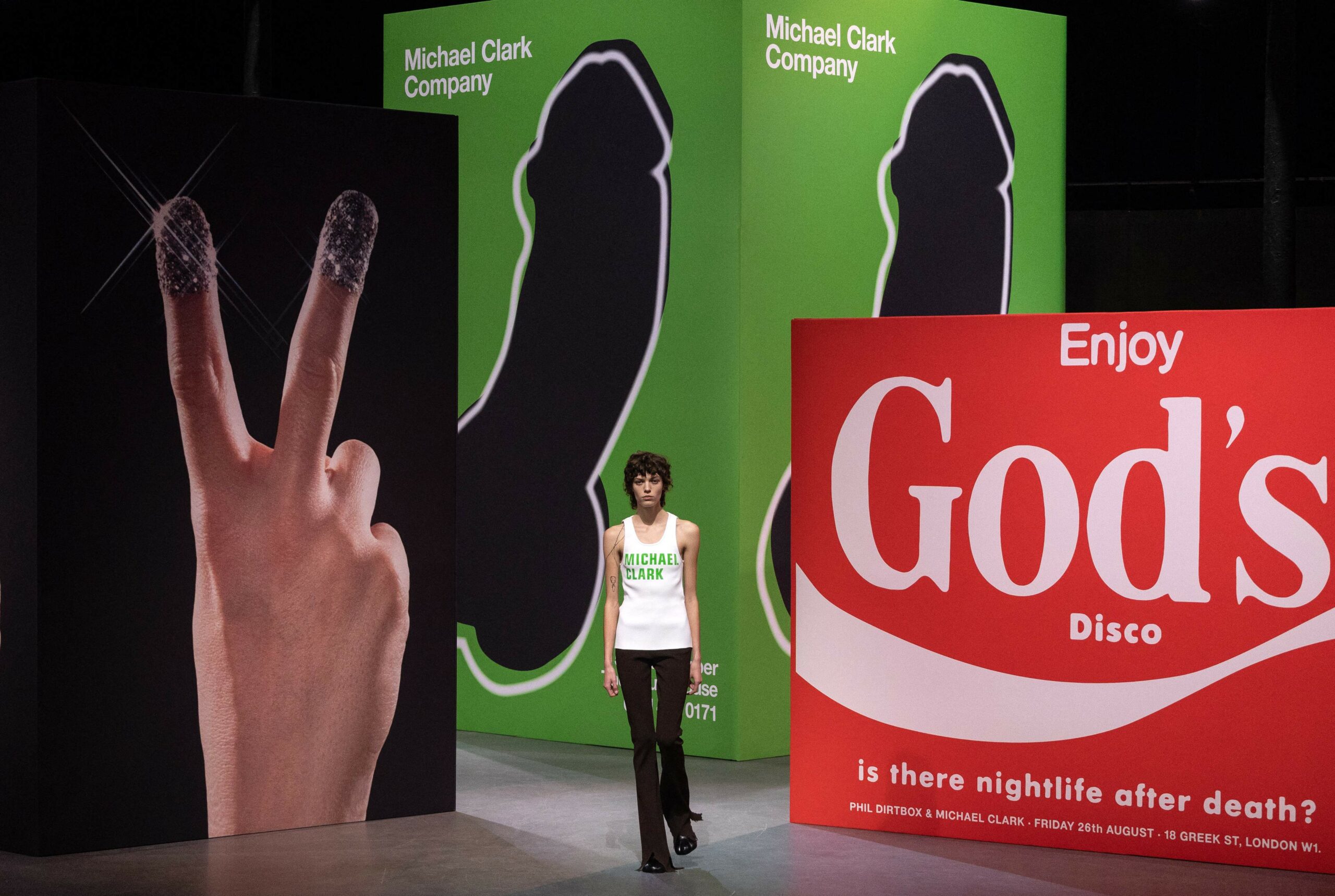
The first thing that caught my eye was the bob. In the world of fashion, there is no haircut more famous than that of Anna Wintour, the famous editor of American Vogue and Global Chief Content Officer of Condé Nast. And there it was: right in front of a giant penis in the Roundhouse. For context, the penis was on a large green plaque erected in the middle of JW Anderson’s catwalk as a tribute to choreography legend Michael Clark, to whom the show was dedicated. There was also a scarlet billboard modeled after one for Coca Cola with the words “Enjoy God’s Disco” and “Is There Nightlife After Death?”.
“At its core, this is a collection about fandom,” Anderson explained in the show notes. That made sense considering how many people were worthy of fangirling in his front row, from Naomi Campbell and Arlo Parks to Bel Powley and Ncuti Gatwa. The result was a vibrant energy that I haven’t felt at a London show in quite some time. Matching this was the collection itself, which featured an eclectic mix of Logomania tees, neon flares, feather boas and slogan jumpers (“Witch?” one asked). One look you’ll inevitably see all over Instagram was the Tesco tote bag dress, which looked exactly like it sounds. The penis found its way onto a stiff vinyl T-shirt, as did the Coca-Cola motif. A typically subversive line from one of the industry’s most respected renegades. OP
Feben
The old Selfridges Hotel, W1H
(AFP via Getty Images)
Stories like Feben Vemmenby’s are one in a million. Born in North Korea and raised in Sweden, the Ethiopian designer spent much of her youth between refugee camps. Fast forward now, and using only her first name, Feben has the favorite tat on the London Fashion Week schedule, promising a fine take on Black Craft each season.
For AW23 everything went as usual. The models stormed the runway in swathes of black evening wear primed with their signature ‘bobbling’ effect – a technique refined with laser cutting technology. A bevy of painterly slip and bodycon dresses also underscored the offering. On Sunday, even the most stiff-lipped editors gushed over Feben’s details. Blazers were upgraded with meticulous corsetry that billowed with ruffled silk, while ruffled dresses made entirely of jeweled beads jingled as they swung past the forehead. The latter, made by local Ghanaian artisans, become another code. “It’s an ongoing collaboration to ensure sustainability in the workforce,” Feben said backstage.
Of course, the city is full of emerging talent, but Feben’s vision feels unique. It’s only a matter of time before she wins an LVMH award, cements her name around the world, and then—when she’s ready—runs a house. Whether that’s in their 10-year plan remains to be seen, but judging by the clothes, it’s a real possibility. If the sequin dresses brushed to look like world maps, buttoned shawls or double-breasted jackets that seemed to transform from crumpled velvet to crocodile print told us anything, it’s that Feben is on the rise. JB
Christopher Kane
The block, N1
(Christoph Kane)
Back to one of my biggest LFW bugbears: uncomfortable seating. This time, the fashion package was pressed onto bales of hay wrapped in brightly colored garbage bags. mine was blue Guests including Alexa Chung, Clara Amfo, Poppy Delevingne and, once again, Anna Wintour squeezed into the squeaky seats to witness Kane’s 1980s-inspired collection, which featured a cast of characters based on family members and neighbors growing up decade based. There were sequined dresses in burgundy and emerald and odd cutting board collars that added an unusual silhouette to otherwise somewhat formal dresses. There was a hustle and bustle the whole time, especially on the backs of fitted, long-sleeved mini dresses, available in charcoal gray and lace.
An unexpected element came through AI-generated animal print dresses with thigh-high slits. There were chicks, rats, pigs and butterflies covering fitted dresses and tops — Kane explained that they’re “for those who want clothing that challenges fashion tastes and standards.” The undeniable highlight, however, was a bright scarlet peplum dress made from a soft-looking rubber. All in all, a much-needed silliness for the inevitably flagging fashion pack. OP
Yuhan Whang
The old Selfridges Hotel, W1H
There’s fashion delay and then there’s annoying delay. Wang’s show fell right in the middle, a dangerous move when you’re appearing on day three in front of crowds of unruly fashion egos pimped up with cheap coffee and Diet Coke, official sponsor of the British Fashion Council. Thankfully, Wang was well received, serving up a bizarre dichotomy of swagger and sugary femininity in knotted lace, pale pink, and sturdy leather jackets printed with chains. Not surprisingly, the subplot of gender and how that translates into western and eastern clothing was there, but this time something didn’t feel right.
I pondered for a moment when a brunette model walked by with rocking open-toed kitten heels laced to the nth degree. Camp! That’s it. That’s what cow-print fluff, wool underwear, samurai swords and tufted cowboy coats were all about. This or that was a master class in problematic costume. Luckily, the designer’s long-held fascination with different ways of expressing emotions across continents – stemming from her study experiences as a Chinese in the UK and US – gives her a free hand.
Subtlety, usually one of the enduring hallmarks of her show, was all but gone, leaving only hints of her earlier work in the patchwork chintz and rosette wools. But it’s not an excavation. For all the world’s academics, it sometimes takes someone who’s lived the East-West, communist-capitalist diaspora to reflect its rich and kitschy appeal. Perhaps the show’s title, “The Women Who Came Back,” referred to that. After all, she has always said that clothing is the medium to explore identity. JB
labrum
Brixton Village, SW9
Labrum’s creative director Fodsay Dumbay is part of a growing cohort in the fashion industry that is using textiles and tailoring to tell otherwise unheard stories about diasporic identity. No wonder then that the Sierra Leone-born designer chose Brixton Village as the location for his show, a site of long-standing disputes between second-generation migrants and their opponents – be it the explicit racism that swept south London in the ’80s and ’90s Britain, or Britain, embraced today’s brighter, shinier adversary, gentrification.
Riffing on Samuel Selvon’s 1965 novel The lonely Londoners, the show began with a poetry reading about arrival, alienation and honoring family heritage. Once this was over, the drummers sped up in front of the catwalk. Models walked the runway in brown tweed blazers and sometimes carried or carried suitcase-style trunks as hat goods. The cream suits featured pinstripes, reminiscent of old colonial uniforms, while traditional geometric patterns splashed rugged coats and straight-cut blazers.
As a whole, the palette felt earthy, if not a little dusty, ochre, cool purple and olive green in thick car coats and ribbed shirts and baggy trousers. The result? A grounded feeling reminiscent of the land Dumbay left behind in search of green pastures. It’s heavy stuff, and the average bourgeois would wonder if fashion as an artistic practice can truly relate to such nuanced and painful stories: families are torn apart, breadwinners send money home, reality falls short of what it promises. Fortunately, Dumbay lived up to it. JB
Don’t miss interesting posts on Famousbio