
Dario Amodei
Dario Amodei trained as a biophysicist, ran research at OpenAI, then co-founded Anthropic in 2021. How the company reached a $965 billion valuation.
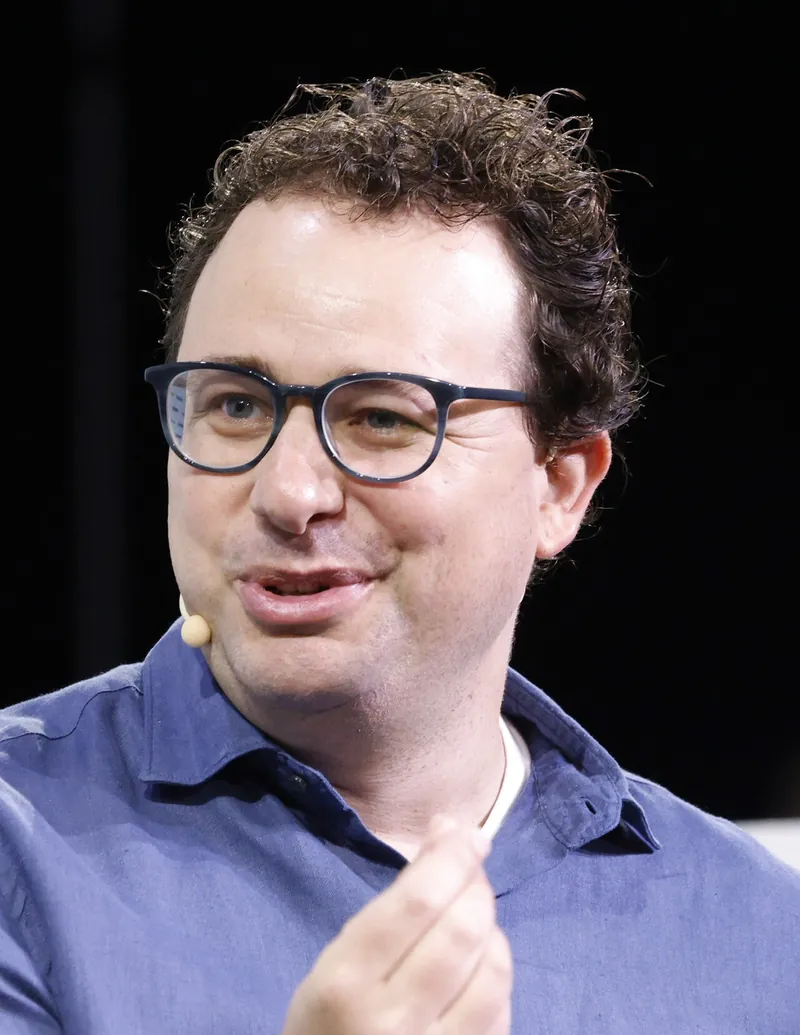
Photo: TechCrunch, CC BY 2.0, via Wikimedia Commons. Resized and converted to WebP.
A Childhood in San Francisco's Mission District
Dario Amodei was born in 1983 and grew up with his younger sister Daniela in the Mission District of San Francisco. In a long interview with Steven Levy of Wired, he traced his parents to two very different places. His mother, Elena Engel, was born in Chicago and worked as a project manager for libraries. His father, Riccardo Amodei, was a leather craftsman from a small town near the island of Elba in Italy. Riccardo fell ill while the children were small and died when they were young adults.
Amodei described himself as a child who cared about numbers more than anything else. "I was just obsessed with manipulating mathematical objects and understanding the world quantitatively," he told Wired. Daniela, four years younger, would later become his co-founder and the president of Anthropic.
Neural Circuits at Princeton
Amodei did his undergraduate study at Stanford and went in, by his own account to Wired, meaning to become a theoretical physicist. He drifted toward the physics of the brain instead. At Princeton he earned a doctorate in biophysics as a Hertz Fellow. The Hertz Foundation lists his thesis as "Network-Scale Electrophysiology: Measuring and Understanding the Collective Behavior of Neural Circuits," and it won the foundation's thesis prize.
The descriptions of that degree vary. The Hertz page calls it a PhD in physics in one place and lists "Biophysics, Physics" in another, and Wired calls the thesis work computational biology. His own website says biophysics. After Princeton he took a postdoctoral post at the Stanford University School of Medicine.
Andrew Ng's Lab at Baidu, Then Google Brain
Amodei moved from biology to machine learning in 2014, when he joined the Silicon Valley lab of the Chinese search company Baidu, working under Andrew Ng. In 2015 he moved to Google, where he was a senior research scientist on the Google Brain team. Both dates come from Wired. Neither source opened for this article gives the months.
Vice President of Research at OpenAI
At OpenAI, Amodei rose to vice president of research. His own site credits him with leading the development of GPT-2 and GPT-3 and names him as a co-inventor of reinforcement learning from human feedback. Wired credits him with the "big blob" paper, its shorthand for his argument that larger models trained on more data and compute would keep getting better in predictable ways.
That scaling view shaped what came next. If capability was going to keep rising with money and chips, Amodei reasoned, the people worried about safety needed to be building frontier models themselves rather than commenting from outside.
A Tent in the Backyard, January 2021
In January 2021 Amodei and a group of OpenAI colleagues met under a tent in his backyard to plan a new company. Wired reports that former Google chief executive Eric Schmidt listened to the launch pitch there. Anthropic was founded that year by seven former OpenAI employees: Dario Amodei, Daniela Amodei, Tom Brown, Jack Clark, Jared Kaplan, Sam McCandlish, and Christopher Olah. Dario became chief executive and Daniela president.
The first funding came to about three-quarters of a billion dollars, according to Wired. Amodei then turned to cloud providers, first Google and later Amazon, for more than $6 billion. Wired notes that Amazon's own regulatory filing in early 2025 valued its Anthropic stake at nearly $14 billion.
A Model Held Back Until March 2023
By mid-2021 Anthropic had a working model. It did not release it. Amodei told Wired that the company was afraid of starting a race: "we don't want to be the one to drop the shoe and set off the race." The first public release came in March 2023. Fortune puts Anthropic's valuation in the spring of 2023 at about $4.1 billion.
Machines of Loving Grace, October 2024
In October 2024 Amodei published a long essay on his website, "Machines of Loving Grace," subtitled "How AI Could Transform the World for the Better." Its central claim is that powerful AI could compress the progress biologists would have made over the next 50 to 100 years into 5 to 10 years, which he called the "compressed 21st century." He also wrote that most people underestimate both how large the upside of AI could be and how bad the risks could be. The essay is the clearest statement of why a chief executive known for warnings about AI keeps building it.
The Pentagon Dispute of 2026
Amodei said Anthropic would not allow its Claude models to be used for autonomous weapons or for surveillance of American citizens. NPR reported that the Defense Department responded by designating Anthropic a supply chain risk. On March 9, 2026, Anthropic filed two federal lawsuits, one in the Northern District of California and one in the federal appeals court in Washington, D.C., alleging illegal retaliation and violations of the First Amendment.
From $380 Billion to $965 Billion in Three Months
The company's private valuation climbed fast in 2026. In February, Anthropic raised a $30 billion Series G at a $380 billion post-money valuation, which Crunchbase counted as the second-largest venture deal on record. By then it had raised nearly $64 billion since 2021. On May 28, 2026, Anthropic announced a $65 billion Series H at a $965 billion post-money valuation, led by Altimeter Capital, Dragoneer, Greenoaks, and Sequoia Capital. The company said its run-rate revenue had passed $47 billion that month, and that $15 billion of the round was money previously committed by cloud providers, including $5 billion from Amazon. CNBC and TechCrunch both reported that the round made Anthropic more valuable than OpenAI.
How the Forbes $15.5 Billion Figure Is Reached
Forbes lists Amodei's net worth at $15.5 billion on a profile updated September 15, 2026, and describes the fortune as self-made from AI. The figure is an estimate. Anthropic is private and no source opened for this article discloses Amodei's ownership percentage, so FamousBio does not compute its own number. Forbes ties its estimate to Anthropic's May 2026 valuation of $965 billion, which means the figure moves with each new funding round.
The jump is visible in Forbes' own numbers. In January 2026, before the Series G and Series H, Fortune quoted a Forbes estimate of about $3.7 billion for each of the seven co-founders. The same Fortune report said all seven had pledged to give away 80 percent of their wealth.
Sources
- If Anthropic Succeeds, a Nation of Benevolent AI Geniuses Could Be Born | WIRED
- Dario Amodei - Hertz Foundation
- Dario Amodei
- Dario Amodei - Machines of Loving Grace
- Dario Amodei
- Anthropic’s billionaire cofounders are giving away 80% of their wealth: ‘The thing to worry about is a level of wealth concentration that will break society’ | Fortune
- Anthropic sues Trump administration over blacklisting decision : NPR
- Anthropic Raises $30B At $380B Valuation In Second-Largest Venture Funding Deal Of All Time
- Anthropic raises $65B Series H at $965B valuation \ Anthropic
- Anthropic tops OpenAI as most valuable AI startup, nears $1T valuation
- Anthropic raises $65 billion, nears $1T valuation ahead of IPO | TechCrunch
Filed Under Topics
Related Life Stories & Dossiers
Further inspiring trajectories within Technology and influential circles.
 Technology$3.2 Billion
Alexandr Wang
Alexandr Wang left MIT after one year to start Scale AI, sold Meta a 49% stake for $14.3 billion in 2025, and now runs Meta Superintelligence Labs.
 Technology$23.4 Billion
Brett Adcock
Brett Adcock co-founded Vettery and Archer Aviation, then started Figure AI in 2022. How the humanoid robot maker reached a $39 billion valuation.