
Ray Brown
Ray Brown, the Pittsburgh-born jazz bassist: Dizzy Gillespie's band, Ella Fitzgerald, the Oscar Peterson Trio, Los Angeles studio years and his own trios.
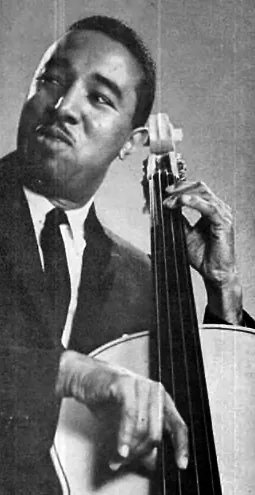
Photo: Kay Musical Instrument Company, Public domain, via Wikimedia Commons. Resized and converted to WebP.
The Hill District and a Bass From the School Orchestra
Raymond Matthews Brown was born on October 13, 1926, in Pittsburgh, Pennsylvania, and grew up in the neighborhood known as The Hill. He started piano lessons at eight. When he wanted to join the school orchestra he could not afford a trombone, so he took the instrument the music department could supply, which was a bass.
In Pittsburgh he heard the bassist Jimmy Blanton, whom he later named as his starting point. "I started from Jimmy Blanton," he told the critic Mike Hennessey in a 1982 interview for Jazz Journal. His mother asked him to finish high school before going on the road, and he did, graduating in 1944.
First Night on 52nd Street, 1945
Brown arrived in New York in 1945, at 19. According to the Gale profile of him reprinted on Encyclopedia.com, on his first night on 52nd Street he met the pianist Hank Jones, who introduced him to Dizzy Gillespie. Gillespie hired him on Jones's word, without an audition. At the rehearsal the next day Brown found that the rest of the band included Charlie Parker, Bud Powell and Max Roach. "If I had known those guys any better I would have probably never gone to the rehearsal," he said later.
In his first year in New York he played on Charlie Parker's Dial session of February 5, 1946, which produced "Diggin' Diz," and on Gillespie's RCA Victor big band session of February 22, 1946, organized by Leonard Feather, which recorded "52nd Street Theme," "A Night in Tunisia" and "Anthropology." At a Musicraft session that May, Gillespie's sextet recorded "One Bass Hit," a feature for Brown. He also appeared with Gillespie in the 1946 film Jivin' in Be-Bop, and he stayed in Gillespie's big band through 1947.
The bassist John Clayton summed up that period when Brown died: "He is the primary contributor to Be-Bop from a bassist's standpoint."
Ella Fitzgerald and Jazz at the Philharmonic
After Gillespie, Brown began a long association with Norman Granz's Jazz at the Philharmonic tours in the late 1940s. He also married the singer Ella Fitzgerald. Sources give different dates for the marriage. The Gale profile gives a wedding on December 10, 1947, in Ohio and a divorce finalized on August 28, 1953, in Juarez, Mexico; the Seattle Times obituary gives 1947 to 1953; the National Endowment for the Arts and the University of Idaho give 1948 to 1952.
The couple adopted a son, Ray Jr., who stayed with Fitzgerald after the divorce. Brown worked as musical director on Fitzgerald's own tours and on the Jazz at the Philharmonic tours, and the two remained friends and collaborators after they separated.
The Oscar Peterson Trio
Brown met the pianist Oscar Peterson on a Jazz at the Philharmonic tour in September 1949. In the early 1950s he became a founding member of the Oscar Peterson Trio, the group he is best known for. The dates differ by source: the NEA and the University of Idaho put his tenure at 1951 to 1966, while the Associated Press obituary has him joining in 1952 and the Gale profile has him leaving in 1965.
In the same period he recorded Parker sides again, in August 1951, with Red Rodney, John Lewis and Kenny Clarke, including "Swedish Schnapps" and "Lover Man."
Los Angeles Studios and the Merv Griffin Show
From 1966 Brown was based in Los Angeles, where he did studio work for about a decade. Frank Sinatra chose him for his television specials, and by 1976, according to Gale, he was playing on The Merv Griffin Show four days a week.
He also moved into the business side of music: publishing, management and record production. Jazz.com reports that he managed the Modern Jazz Quartet and the early career of Quincy Jones, and produced concerts at the Hollywood Bowl. For Concord he produced a comeback album for the Seattle singer Ernestine Anderson.
In 1974 he formed the L.A. Four with the saxophonist Bud Shank, the guitarist Laurindo Almeida and the drummer Shelly Manne, later replaced by Jeff Hamilton. One source, Jazz.com, dates the group to 1972.
Trios With Gene Harris, Benny Green and Geoff Keezer
From the late 1970s he led his own trio, and it was his main touring band for two decades. The pianists included Gene Harris, Monty Alexander, Benny Green, Geoff Keezer and, from 2000, Larry Fuller. The drummers included Jeff Hamilton, Lewis Nash, Gregory Hutchinson and Karriem Riggins. The trio albums Bass Face (1994, with Green and Hamilton) and Seven Steps to Heaven (1995, with Green and Hutchinson) came from that run. The Seattle Times also credits him with mentoring Diana Krall.
He played Seattle every year, and in 2000 Telarc released his album Live at Starbucks. He also played cello and had a hybrid instrument built that the Seattle Times describes as a forerunner of the piccolo bass.
In 1982, at 55, he put his career this way. "If you live long enough, you get to be the slowest gun in the west!" he told Hennessey. "I'm able to play what I like to play and as long as people want to listen, that's fine with me."
Grammys, the NEA Jazz Masters and Berklee
The Recording Academy lists eight Grammy nominations and three wins for Brown. The first came at the sixth Grammy Awards in 1964, for Best Original Jazz Composition, for "Gravy Waltz," a tune he wrote with Steve Allen. He also won Best Jazz Instrumental Performance, Group, with the Oscar Peterson Trio at the 33rd and 34th ceremonies, in 1991 and 1992, for the Blue Note live recordings The Legendary Oscar Peterson Trio Live at the Blue Note and Saturday Night at the Blue Note.
The National Endowment for the Arts named him an NEA Jazz Master in 1995, and Berklee College of Music gave him an honorary degree the same year. The NEA page also records his election to the DownBeat Jazz Hall of Fame in 2003. His papers are held by the International Jazz Collections at the University of Idaho.
The Jazz Kitchen, Indianapolis, July 2002
Brown was still touring at 75. On July 2, 2002, while finishing an engagement at the Jazz Kitchen in Indianapolis, he played golf in the afternoon and then died in his sleep in his hotel room. He lived in Sherman Oaks, California, and was survived by his wife, Cecilia, and his son, Ray Jr., of Hawaii.
No estimate of his estate from an acceptable source was published, so this article gives no net worth figure.
Sources
- Ray Brown | National Endowment for the Arts
- Late bassist Ray Brown was a Seattle favorite, friend to local musicians | The Seattle Times
- About | Ray Brown Collection
- Ray Brown dies - jazz kitchen loses another cook | Mail & Guardian
- Brown, Ray | Encyclopedia.com
- JJ 07/82: First Bass - Ray Brown interviewed /1 - Jazz Journal
- Ray Brown Grammy Awards and Nominations, Song & Bio
- Honorary Degree Recipients | Berklee
- Ray Brown - Raymond Matthews Brown - Jazz.com
Filed Under Topics
Related Life Stories & Dossiers
Further inspiring trajectories within Entertainment and influential circles.
 Entertainment
Dan McCafferty
Dan McCafferty, the Dunfermline singer who fronted Nazareth from 1968: The Shadettes, Razamanaz, Love Hurts, Hair of the Dog, his COPD retirement and death in 2022.
 Entertainment
Justin Hayward
Justin Hayward, the Moody Blues singer from Swindon, on joining the band in 1966, writing Nights in White Satin, Forever Autumn, his solo work and his 2026 tour.
 Entertainment
Richard Carpenter
Richard Carpenter arranged and produced the Carpenters' records. His Yale and Long Beach years, A&M, three No. 1 hits, Karen's death and the royalty suit.