
Perovskites are one of the most promising new materials for solar cell technology. Now, University of Rochester engineers have developed a new way to more than triple the material’s efficiency by adding a layer of reflective silver underneath.
For nearly a century, silicon has been the material of choice for making solar cells thanks to its abundance and efficiency in converting light into electricity. But in the last decade alone, a new competitor has quickly risen through the ranks — perovskite, which is much cheaper and already catching up with silicon in terms of efficiency.
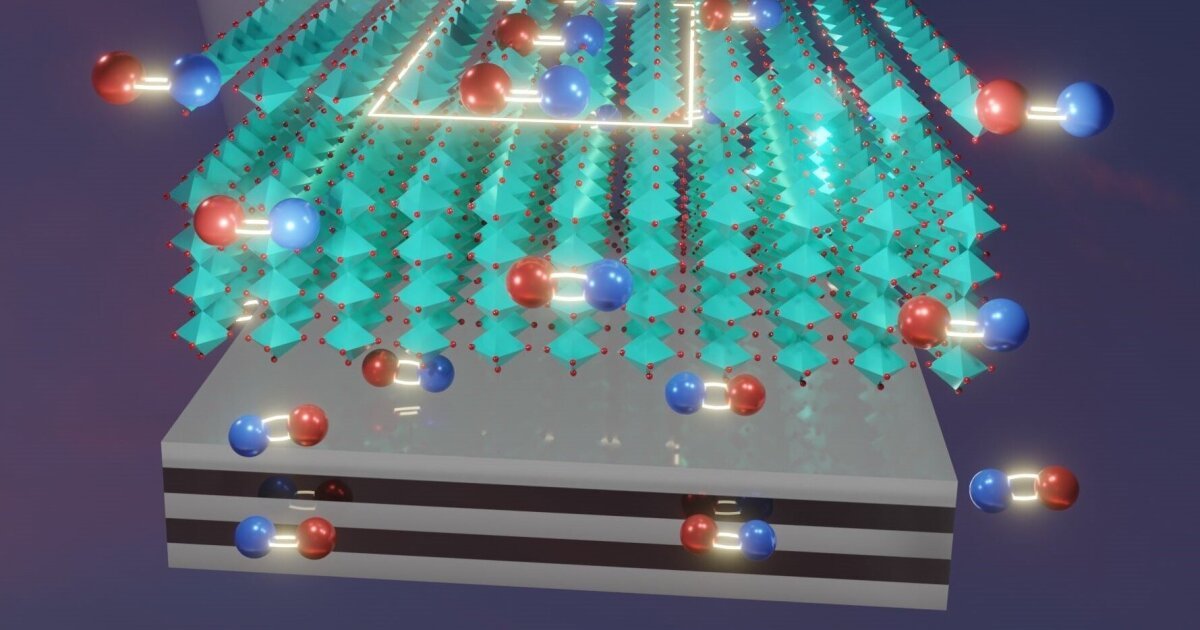
Now a new study has increased the efficiency of perovskite by three and a half times without optimizing the material itself. Instead, the team found that adding a layer of a different material underneath altered the interactions of the electrons in the perovskite, reducing an energy-sapping process.
Perovskites and other photovoltaic materials generate electricity by allowing sunlight to excite electrons in the material, causing them to jump out of their atoms and ready to be guided to create an electric current. But sometimes electrons fall back into the “holes” they left, reducing the overall current and therefore the efficiency of the material. This is what is known as electron recombination.
The researchers found that they were able to drastically reduce electron recombination in perovskite by placing it on a substrate composed of either all silver or alternating layers of silver and aluminum oxide. The team says this creates a kind of mirror that creates inverted images of the electron-hole pairs, reducing the chances of electrons recombineing with the holes. In tests, engineers showed that adding these layers increased light conversion efficiency by 3.5 times.
“A piece of metal can do as much work as complex chemical engineering in a wet lab,” said Chunlei Guo, lead author of the study. “As new perovskites emerge, we can then use our physics-based method to further improve their performance.”
The research was published in the journal nature photonics.
Source: University of Rochester
Source: newatlas.com
Don’t miss interesting posts on Famousbio