
Navi Pillay
Navi Pillay, the Durban lawyer who sat on the Rwanda tribunal and ran the UN human rights office, won the 2026 Nobel Peace Prize. How she got there.
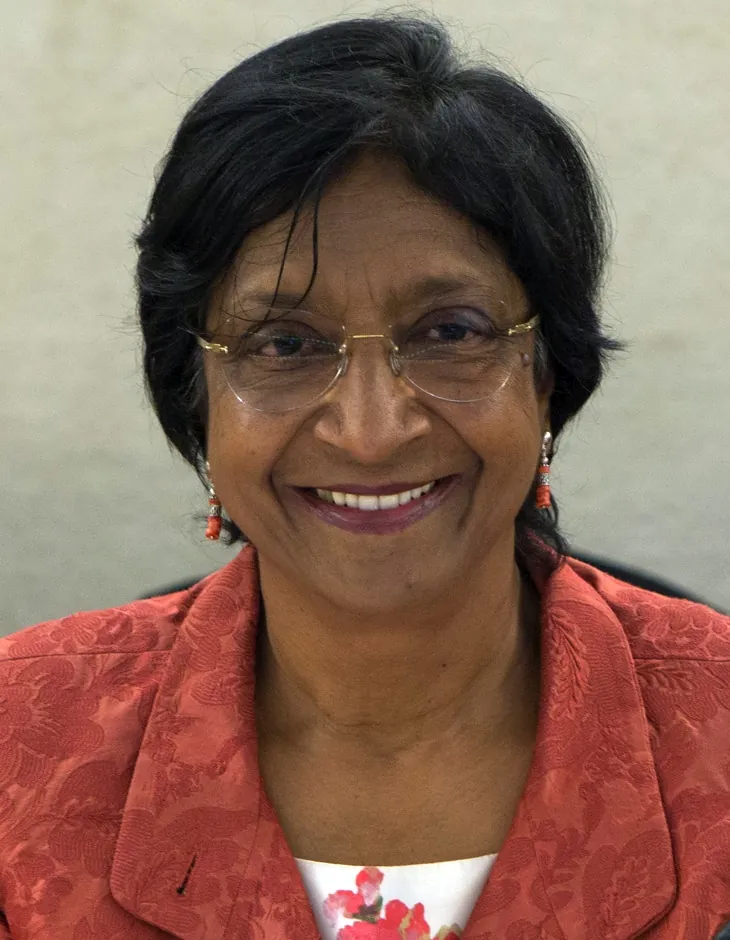
Photo: US Mission Geneva, Public domain, via Wikimedia Commons. Resized and converted to WebP.
Clairwood, Durban, 1941
Navanethem Pillay was born on 23 September 1941 in Clairwood, a district of Durban in what was then the province of Natal. She was the fifth of eight children of Narrainsamy Naidoo, a bus driver who also fished and took other work to feed the family, and Santhama Naidoo, who ran the home. According to a biography of Pillay cited by the Hindustan Times, her grandparents had come to Natal from India in the 1890s as indentured labourers.
She wanted to be a lawyer early, and was told by teachers that the profession was for children whose fathers were well-to-do, she recalled to The National. Speaking to Ms. Magazine in 2022, she described her father as "a very oppressive father" and said her mother had been married at 16. She took a BA and then a law degree at the University of Natal in the 1960s, according to South African History Online, and married Gaby Pillay, also a lawyer.
A Law Practice of Her Own in Natal, 1967
When she qualified, no firm would hire her. "No law firm would employ me because they said they could not have white employees taking instructions from a coloured person," she told the BBC in 2008. In 1967 she opened her own practice, the first woman to do so in Natal, according to the International Criminal Court's biography of her. She stayed in practice for 28 years.
The clients were the people the apartheid state had put out of public life. Her first case, after articles served under Narainsamy Thumbi Naicker, a Natal Indian Congress member then under house arrest, was the defence of Phyllis Naidoo, a banned person. In 1971 she defended ten members of the Non-European Unity Movement charged under the Terrorism Act. In the mid-1970s she represented the Black Consciousness activists Saths Cooper and Strini Moodley. South African History Online credits her with winning, in 1973, the right of political prisoners to see a lawyer.
The 1971 Affidavit and the Robben Island Appeal
The work became personal when the police detained her husband. She could not apply for his release, so she went to court to stop his torture instead. "I was the first one to do so because my husband was in detention, and I knew I couldn't apply for his release," she told Ms. Magazine. Affidavits from other detainees followed hers, and she said they were sent on to the United Nations office that dealt with apartheid, where they fed the campaign for an international convention against torture.
She also took on the prisoners of Robben Island. "I was representing men who were imprisoned on Robben Island along with Mandela," she told the BBC. An appeal she brought to the provincial court won basic legal rights for Mandela and the men held with him, and it put her under watch by the security police. She later joined the Women's National Coalition, which worked on the equality clause in South Africa's post-apartheid constitution, and co-founded the women's rights group Equality Now. The sources differ on the year: South African History Online gives 1985, while Ms. Magazine gives 1992, naming Jessica Neuwirth as her co-founder.
Between cases she went back to study. She earned a master's degree in law and then a Doctor of Juridical Science at Harvard, and The National reports she was the first South African to receive that doctorate.
The Rwanda Tribunal and the Akayesu Judgment
In 1995, the year after South Africa's first democratic election, she was named an acting judge of the High Court, according to South African History Online. The BBC and the International Criminal Court both record her as the first black woman to sit on that court, and the BBC adds that Nelson Mandela nominated her.
The same year she went to the International Criminal Tribunal for Rwanda, set up by the UN after the 1994 genocide. She spent eight years there, four of them as president. The case that made her name was the trial of Jean-Paul Akayesu, in which the tribunal found that rape and sexual violence could amount to genocide and to a crime against humanity. The Norwegian Nobel Committee noted in 2026 that the same case brought the first charge of incitement to genocide based purely on propaganda. "From time immemorial, rape has been regarded as spoils of war. Now it will be considered a war crime," she said in an interview quoted by South African History Online. "We want to send out a strong signal that rape is no longer a trophy of war."
She told Ms. Magazine that she brought in Jessica Neuwirth to help write up the testimony of women who described gang rape during the killings.
The First Bench of the International Criminal Court, 2003
In February 2003 she was elected to the first group of judges of the International Criminal Court and sat in its Appeals Division. The ICC's own page gives a term running to 2012, but she left in August 2008 for a new post, according to South African History Online. The same year, 2003, she received the first Gruber Prize for Women's Rights.
Six Years as UN High Commissioner for Human Rights
She was nominated on 24 July 2008, and the General Assembly approved her four days later, South African History Online records. She took office on 1 September 2008. The BBC profiled her that week as the new UN rights chief. Her mandate was renewed for two years in 2012, and she gave her final address to the Human Rights Council in Geneva in June 2014, as JURIST reported. In 2009 Forbes placed her 64th on its list of the world's most powerful women.
The Gaza Commission of Inquiry
She went on to chair the UN's Independent International Commission of Inquiry on the Occupied Palestinian Territory. In September 2025 the commission concluded that Israel was committing genocide in Gaza. In an interview with AFP that month, she said she saw "similarities" with Rwanda and called the video evidence "just traumatic." She said she would leave the commission in November 2025, citing her age and her health.
The same interview showed how long a view she takes. "I never thought apartheid will end in my lifetime," she said, and justice "is a slow process." The International Criminal Court, she pointed out, "does not have its own sheriff or police force to do the arrests." According to the Nobel committee, she also sits as a judge at the International Court of Justice in the case in which Myanmar is accused of genocide.
The Nuremberg Courtroom, October 2026
On 9 October 2026 the Norwegian Nobel Committee awarded her the Nobel Peace Prize "for her efforts to promote peace and international law." At 85 she is the fifth South African to receive the prize and the first South African woman, the Mail & Guardian reported. The committee cited her years on the High Court, the Rwanda tribunal, the ICC, the UN rights office and the International Court of Justice.
She heard the news while attending the Nuremberg Forum and held her first press conference as a laureate in the Nuremberg courtroom where Nazi leaders were tried after the Second World War, according to Deutsche Welle. She dedicated the prize to "all of the survivors of international crimes." UN Secretary-General Antonio Guterres and President Cyril Ramaphosa sent congratulations. Israel's Foreign Ministry condemned the choice, accusing her of "politically motivated demonization of Israel" and pointing to her work on the Gaza commission.
Gaby Pillay is no longer living; Ms. Magazine and The National both report that the couple had divorced before his death. She has two daughters, both adults, and The National mentions a grandchild.
Sources
- Nobel Peace Prize 2026 - Press release - NobelPrize.org
- Navi Pillay becomes fifth South African to win Nobel Peace Prize | Mail & Guardian
- Nobel Peace Prize 2026 goes to Navanethem 'Navi' Pillay
- Navanethem (Navi) Pillay | South African History Online
- Judge Navanethem Pillay | International Criminal Court
- BBC NEWS | Special Reports | Profile: New UN human rights chief
- Born Under Apartheid, Navi Pillay Has Climbed to Global Heights in Promoting Human Rights Law - Ms. Magazine
- Newsmaker: Navi Pillay | The National
- Outgoing UN rights chief delivers final remarks to council - JURIST - News
- Top UN Gaza investigator hopeful Israeli leaders will be prosecuted
- Navi Pillay wins Nobel Peace Prize: Her grandparents were Indian indentured labourers | Trending
Filed Under Topics
Related Life Stories & Dossiers
Further inspiring trajectories within Politics and influential circles.
 Politics
Edwina Currie
Edwina Currie sat for South Derbyshire from 1983 to 1997, resigned as a health minister over salmonella in eggs, and wrote the diaries that named John Major.