
Karl Deisseroth
Karl Deisseroth, the psychiatrist who built optogenetics, shared the 2026 Nobel Prize in Physiology or Medicine. How the method was built and what it paid.
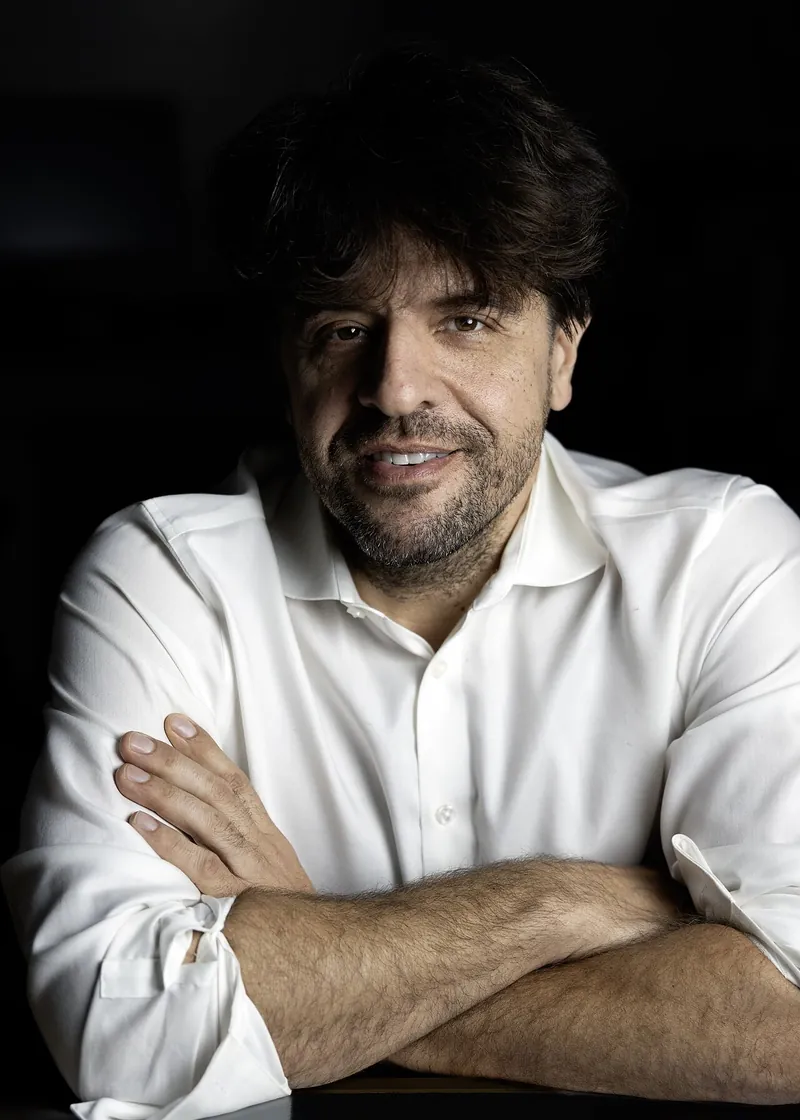
Photo: Cmichel67, CC BY-SA 4.0, via Wikimedia Commons. Resized and converted to WebP.
Boston, 1971, and a Father Who Taught Medicine
Karl Deisseroth was born in Boston, Massachusetts, in 1971, the year, as Stanford Medicine later pointed out, that Dieter Oesterhelt isolated the first light-activated microbial protein. He has an older sister and a younger sister. His father was a physician and professor; his mother taught high school chemistry. As a boy he read prose and poetry as much as science and, by Stanford Medicine's account, wanted to be a writer.
The interest in the brain came before any training. "As a little kid, I was kind of introspective and thought about what was going on in my head," he told Yeka Aponte in a 2021 interview for the journal Neurophotonics. He was curious, he said, about "how words and sentences could make me feel." His own curriculum vitae, posted on his Stanford lab site, lists an A.B. in biochemical sciences from Harvard in 1992, summa cum laude, after a run of Harvard scholarships from 1988 onward. The Stanford faculty profile confirms the Harvard degree without giving the year.
An MD and a PhD at Stanford, Then a Psychiatry Rotation
He went west for an MD-PhD program at Stanford: a PhD in neuroscience in 1998 and an MD in 2000, according to both the Nobel Assembly's press release and the Kyoto Prize Foundation's biography of him. The Kyoto page also lists a medical internship in 2000 to 2001 and a psychiatry residency with a postdoctoral fellowship from 2000 to 2004 at Stanford; his own CV puts the residency at Stanford Hospital and Clinics in the same years. The Stanford profile adds board certification by the American Board of Psychiatry and Neurology.
Psychiatry was not the plan. He told Aponte that he had considered neurosurgery, neurology, anesthesiology, even ophthalmology as routes into the brain, "but I didn't even consider psychiatry, not even for a moment." Then came the rotation that medical school requires: "it just blew my mind." What held him, he said, was the scale of the disability caused by psychiatric disease, and the fact that psychiatrists got to ask the most interesting questions even when they could not answer them.
Channelrhodopsin in Rat Neurons, 2005
The protein at the center of his work was found by others. In the early 2000s Peter Hegemann and Georg Nagel, working in Germany, discovered channelrhodopsin in Chlamydomonas, a single-celled alga that swims toward light. When blue light hits the protein, a channel opens, charged ions flow in, and the cell produces an electrical impulse. Whatever cell they put the protein into became light sensitive.
Deisseroth, an assistant professor at Stanford from 2004, put the gene for channelrhodopsin into nerve cells from rats and fired them with blue light. The result appeared in 2005. The Kyoto Prize citation points to the paper, "Millisecond-timescale, genetically targeted optical control of neural activity," listed as Boyden et al. in Nature Neuroscience, volume 8. Two years later, according to the Nobel press release, the switch worked in the brains of living mice. The Kyoto reference list for the same period includes a 2007 paper in Nature, listed as Zhang et al., titled "Multimodal fast optical interrogation of neural circuitry."
Two pieces of other people's technology made it practical, he told Neurophotonics. Microbial opsins generate tiny currents, so a standard transgenic animal with five to seven gene copies was never going to drive a neuron hard enough; the viral vectors developed in the late 1990s, lentiviruses and adeno-associated viruses, delivered the gene at high copy number instead. And the laser diodes coupled to fiber optics that his lab described in 2007 got enough light to the right place inside a moving animal. That fiber-optic interface, he said, is "still the workhorse of optogenetics, around the world." The NIH gave him a Director's Pioneer Award in 2005, a year after he started his lab.
CLARITY and the See-Through Brain, 2013
Optogenetics was "up and running between 2004 and 2010 or so," he said, and by then it was clear the lab lacked the wiring information to make sense of what it was switching on. His answer was what he now calls hydrogel tissue chemistry: build a hydrogel inside every cell of an intact piece of tissue, anchor the proteins and RNA to it, then wash out the lipids with strong detergents. Most of a brain's opacity comes from light scattering where lipid meets water, so the organ turns transparent while its cells stay where they were. The first version, published in 2013, was named CLARITY, and the lab later used the same framework to sequence the transcripts of single cells inside intact tissue. Other lines of work he described to Neurophotonics include single-cell optogenetic control in a living mouse brain in 2012 using two-photon microscopy, and holograms made with spatial light modulators that drive hundreds of individually chosen cells at once.
The $3 Million Breakthrough Prize and the Kyoto Prize
Stanford made him a full professor of bioengineering and of psychiatry and behavioral sciences in 2012 and gave him the D.H. Chen professorship the same year; the Howard Hughes Medical Institute named him an investigator in 2014. The National Academy of Medicine elected him in 2011, the National Academy of Sciences in 2012, and the National Academy of Engineering in 2019.
On November 9, 2015, Stanford Medicine reported that he had won a Breakthrough Prize in life sciences, $3 million in unrestricted funds, for optogenetics. Stanford's news office called it the 2016 prize; his faculty profile lists it under 2015. The same report noted the Albany Award and the NIH's Lurie Prize that year, and his seat on the advisory committee of the White House BRAIN Initiative. "Optogenetics' biggest impact by far has been in enabling thousands of discoveries about how neural circuits control behavior," he said then. In 2018 the Inamori Foundation awarded him the Kyoto Prize in Advanced Technology, citing three contributions: showing that channelrhodopsin-2 could control action potentials in the mammalian brain on the millisecond scale, using that control to probe learning, fear, reward and decision-making, and supplying evidence that psychiatric and neurodegenerative disorders are disorders of circuit activity.
The Lasker Award of September 2021, Shared With Hegemann and Oesterhelt
On September 24, 2021, he received the Albert Lasker Basic Medical Research Award, sharing the $300,000 prize with Peter Hegemann of Humboldt University of Berlin and Dieter Oesterhelt of the Max Planck Institute of Biochemistry in Martinsried. The citation, as Stanford Medicine quoted it, was "for the discovery of light-sensitive microbial proteins that can activate or deactivate individual brain cells, leading to the development of optogenetics and revolutionizing neuroscience." Oesterhelt had isolated the first such opsin in 1971. Hegemann, his doctoral student, had found the algal opsin gene and shown that it carried current across the membrane of a frog egg. On January 24, 2023, the Japan Prize Foundation named Deisseroth a recipient of the Japan Prize in Life Sciences, according to the Kyoto Prize news page.
Asked by Stanford Medicine what explained his success, he gave one word, "Curiosity," and a line his lab treats as policy: "We don't want to do things that would get done anyway. We want to build a telescope to see a part of the sky nobody has ever seen."
Projections, Random House, June 2021
His book for general readers, Projections: The New Science of Human Emotion, was published by Random House on June 15, 2021, at 272 pages, with a paperback from Random House Trade Paperbacks on March 28, 2023. He wrote it in fixed blocks: "I tried to block out two hours a day for a couple years, which is when I got the writing done," he told Neurophotonics. Each chapter opens with one or two people in an altered state, grief, mania, an eating disorder, and branches from their symptoms into the science. He described the book as his attempt to reduce the stigma around mental illness by showing the public how far the biology had come. The publisher's author note says he also directs Stanford's undergraduate degree in bioengineering.
Patients With Treatment-Resistant Depression
He still practices. The Stanford profile describes a psychiatrist specializing in affective disorders and autism-spectrum disease who uses medications along with neural stimulation, and the publisher's note says he treats patients with mood disorders and autism. He described the clinic to Aponte: "As a psychiatrist, I treat patients with depression, severe and treatment-resistant depression. These are people who come to me who have tried in the outpatient community, have been through four or five or more courses of medications, or even electroconvulsive therapy, and things are not working." His other specialty is adults with autism, for whom, he said, no medication corrects the core symptoms; what he can treat is the anxiety that comes with them.
The patients set the lab's questions. Depression, he said, taught him that for these patients "the ability to feel positive about things is gone. It has been deleted from their life," which pushed his research toward how positive or negative valence gets attached to experience. He told Aponte he saw the value of optogenetics in understanding rather than in direct treatment, though he noted that his colleague Botond Roska had that year put a microbial opsin into the retina of a blind person and restored some sight.
Michelle Monje and Five Children
He is married to Michelle Monje, a physician-scientist whom Stanford Medicine described in 2021 as an associate professor of neurology and neurological sciences. The Lasker Foundation, which interviewed the couple together on October 17, 2023, names her Michelle Monje-Deisseroth and lists her as a MacArthur Fellow, a Stanford professor and a Howard Hughes investigator. They have five children. Stanford Medicine in 2021 counted four school-age children and an adult son in medical school; the publisher's note gives the same total. FamousBio does not name them.
The household runs on a schedule he described without embellishment: he gets up early, makes breakfast and the lunches, and does the school drop-offs, and the evening is "a complex well-orchestrated dinner choreography." Both spouses run clinical work, so when an emergency comes, the partner who is not doing something critical drops everything. His advice to physician-scientists was to arrange the clinic, the lab, the teaching and the writing so that they push in one direction, because the MD-PhD who feels pulled between practice and research "ends up abandoning one of them," as he put it.
October 5, 2026: The Nobel Prize in Physiology or Medicine
On October 5, 2026, the Nobel Assembly at Karolinska Institutet awarded the Nobel Prize in Physiology or Medicine jointly to Deisseroth, Hegemann and Nagel "for their discoveries concerning light-gated ion channels and optogenetics." The press release divides the credit plainly: Hegemann and Nagel discovered channelrhodopsin, Deisseroth turned it into a light-controlled switch for nerve cells. "Optogenetics provides opportunities for mapping the brain in a way that we could once only dream of," said Per Svenningsson, chair of the Nobel Committee for Physiology or Medicine. The Assembly listed his affiliation as the Howard Hughes Medical Institute and Stanford University, and noted that researchers are now using the method in attempts to restore sight in people with visual impairment. The Kyoto Prize Foundation posted the news the same day.
12 Million Kronor Split Three Ways
FamousBio publishes no net worth for Deisseroth. None of the sources opened for this article, including his Stanford profile, his CV, and the Nobel, Kyoto and Lasker pages, discloses a salary, an equity stake or a company role, and the site does not compute a figure from inputs it cannot source. What is public is prize money: $3 million unrestricted from the Breakthrough Prize announced in November 2015, a one-third share of the Lasker Foundation's $300,000 in 2021, and a one-third share of the 2026 Nobel Prize's 12 million Swedish kronor, which the Nobel Assembly said is shared equally among the three laureates. Those are gross awards on the dates stated, before tax, and they are not a measure of his wealth.
Sources
- Press release: Nobel Prize in Physiology or Medicine 2026 - NobelPrize.org
- Karl Deisseroth | Kyoto Prize
- Karl Deisseroth's Profile | Stanford Profiles
- cv
- Karl Deisseroth shares Lasker Award for research on microbial molecules behind optogenetics
- An Interview With Michelle Monje-Deisseroth and Karl Deisseroth - Lasker Foundation
- Projections by Karl Deisseroth: 9781984853714 | PenguinRandomHouse.com: Books
- Deisseroth wins $3 million Breakthrough Prize
- Illuminating the brain: an interview with Karl Deisseroth - PMC