
Edwina Currie
Edwina Currie sat for South Derbyshire from 1983 to 1997, resigned as a health minister over salmonella in eggs, and wrote the diaries that named John Major.
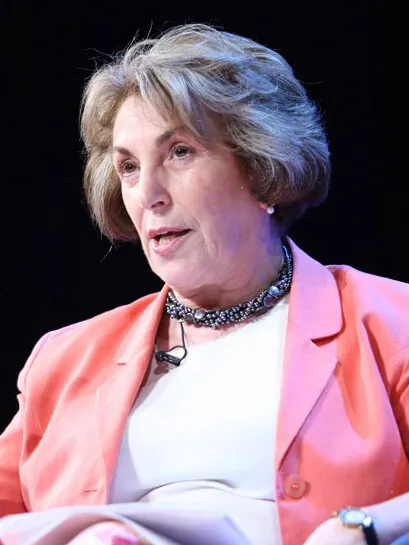
Photo: NHS Confederation, CC BY 2.0, via Wikimedia Commons. Resized and converted to WebP.
Liverpool, Oxford and Birmingham City Council
Edwina Currie was born Edwina Cohen in Liverpool, the daughter of Orthodox Jewish parents, according to the Encyclopaedia Judaica entry on her. Her own website adds that her grandparents came from Poland. The UK Parliament's Hansard record of members gives her date of birth as 13 October 1946, which makes her 80 this month. She went to school in Liverpool, then to Oxford and the London School of Economics. In a 2002 radio interview she recalled being at St Anne's College at the same time as Mary Archer. After university she taught economics and economic history and tutored and lectured for the Open University.
Her elected career started in Birmingham in 1975, when she won a seat on the city council. She held it until 1986 and chaired the Central Birmingham Health Authority, the job that gave her the health brief she later carried into government.
South Derbyshire, June 1983
On 9 June 1983 Currie was elected Conservative MP for South Derbyshire, the same day Tony Blair, Gordon Brown and Jeremy Corbyn entered the Commons. She was one of 23 women among 656 members. Hansard records her first contribution on 23 June 1983 and 5,829 in all by the time she left. In 1985 she became parliamentary private secretary to Sir Keith Joseph at the Department of Education and Science, and the BBC's 2002 profile of her said her public profile rose rapidly from 1983 on the strength of her opinions.
The hours were long. In the 1983 to 1987 Parliament, she said in 2002, the House rose on average at 12.47am. "Margaret Thatcher believed that home was a place you go to when there's no more work to do and she practised it and we worked like Trojans."
Junior Minister at the Department of Health, 1986 to 1988
In 1986 Thatcher made her Under-Secretary of State at the Department of Health and Social Security, which became the Department of Health during her time there. Her own account of the post lists responsibility for campaigns on women's health and healthier lifestyles, membership of the first UK team to tackle HIV and AIDS in 1986, the introduction of the MMR vaccine for children in 1988, and the nationwide screening programmes for breast and cervical cancer, which she calls her greatest achievement. The BBC recorded one of the campaign appearances: at the start of the AIDS scare she went on television and showed how to put on a condom.
The same two years produced the remarks that made her name. She told northerners they were dying of "ignorance and chips". She advised the elderly to get through winter in a pair of long-johns and was called patronising for it. On AIDS she said: "Good Christian people who would not dream of misbehaving will not catch Aids." In December 1988 BBC Radio 4 listeners voted her runner-up to Thatcher as Woman of the Year. It was the month she left office.
The Salmonella Interview of 3 December 1988
On 3 December 1988 Currie said in a television interview: "Most of the egg production in this country, sadly, is now affected with salmonella." Ministers at the Ministry of Agriculture were reported to be angry. A spokesman there said more than 30 million eggs had been eaten every day the previous year, against 26 reported salmonella outbreaks. Her own officials at the Department of Health could not produce evidence that most chickens were infected. The British Egg Industry Council called the remarks "factually incorrect and highly irresponsible" and took legal advice on suing her; its spokesman put the odds of an infected egg at less than 200 million to one. The National Farmers' Union said it might seek damages.
Thatcher and the Health Secretary, Kenneth Clarke, backed her at first. Two weeks later, with writs from the farming industry mounting, she resigned. Egg sales fell 60 percent, four million hens were slaughtered, and the government paid a compensation package of millions of pounds to buy surplus eggs and cover the slaughter. The BBC's look back 25 years later recorded 12,302 cases of the PT4 salmonella strain most often found in poultry at the time of her remark. After the British Lion scheme began vaccinating hens in 1998, cases fell 54 percent in three years, and there were 229 in 2012. She wrote up the two years in Life Lines: Politics and Health 1986-88, published by Sidgwick and Jackson in 1989.
The Home Office Post She Declined and the 1994 Consent Debate
After the 1992 election John Major, by then Prime Minister, called her in and offered her the post of Minister of State at the Home Office. She refused. She had two prisons in her constituency, she said in 2002, and could see herself rowing with colleagues over prison policy and resigning a second time: "I'd been there, I'd done that and I wasn't going to go through it." Her website confirms the offer and the refusal, and she stayed on the backbenches for the rest of her time in the House.
From there she led on one cause in particular. A supporter of Stonewall and of the Tory Campaign for Homosexual Equality, she called a debate in February 1994 on an equal age of consent for gay men, the first in the Commons in 25 years by her count. The House voted to lower the age from 21 to 18. The Spectator named her Campaigner of the Year in 1994 for the work. In June that year she stood as the Conservative candidate for the European Parliament in Bedfordshire and Milton Keynes, in an election that left her party with 18 seats, and from 1995 to 1997 she chaired the Conservative Group for Europe. She also pressed ministers to accept responsibility for Gulf War Syndrome among veterans of the 1991 war, and after a care worker in her constituency was jailed for abusing people with learning disabilities she set up the charity VOICE UK to help such witnesses and victims.
Four days before the 1 May 1997 election she wrote in the Express on Sunday that Labour would win a majority of about 100, that much of the blame was "down to John Major", and that "a bloodbath in the Tory party" would follow. She lost South Derbyshire that night. Hansard records her last contribution on 18 March 1997.
A Parliamentary Affair and the Novels After Westminster
Her first novel came out while she was still an MP. A Parliamentary Affair, which the BBC described as a tale of love and betrayal behind the scenes at Westminster, went straight into the best-seller lists in 1994. The best advice she had on becoming an author, she said on her website, was "Write what you know". By 2002 there were six novels: A Parliamentary Affair, This Honourable House, Chasing Men, A Woman's Place, She's Leaving Home and The Ambassador, the last of them published in 1999. Three are set in Parliament.
Broadcasting ran alongside the books. She worked at LBC, stood in for Jimmy Young on BBC Radio 2, and by 2002 was fronting Late Night Currie, a phone-in on BBC Radio 5 Live on Saturday and Sunday nights. She told listeners she looked after them "in a way, I hope, that I used to look after my constituents".
The 1987 to 1992 Diaries and John Major
On 28 September 2002 The Times began serialising her diaries for 1987 to 1992. They revealed a four-year affair with John Major that began in 1984, when she was a backbencher and he was a whip in Thatcher's government, and ended in early 1988 after his promotion to the Cabinet as Chief Secretary to the Treasury. She had always denied having an affair while in office. Major gave The Times a statement: "It is the one event in my life of which I am most ashamed and I have long feared would be made public." He said his wife Norma had known for many years and had forgiven him. Mary Archer told Radio 4's Today programme she was "a little surprised, not at Mrs Currie's indiscretion but at a temporary lapse in John Major's taste".
Currie gave her first broadcast interview on the subject to 5 Live on 2 October 2002. "I ended it, I ended it by writing to John," she said, explaining that once he was in the Cabinet the risks were too high, with the IRA active and Major needing to give his bodyguards the slip. Asked whether she was ashamed, she said: "I wasn't ashamed at the time and I'm not ashamed now." On the timing, she said she had held the answers to many questions "until they could do no more damage". She took two weeks' leave from her programme. A second volume of diaries, covering 1992 to 1997, followed in September 2012.
Late Night Currie, Strictly and Whaley Bridge
Currie's first marriage, to Ray Currie, lasted 29 years by her account. They formally separated in 1997, and he never knew of the affair. The BBC's reports in 2002 said she married John Jones, a retired detective, in 1999; in her interview that October she said she had divorced and remarried "last year", which would put the wedding in 2001. The two sources disagree and both are given here. She has two daughters from the first marriage, little girls in the 1980s and grown women by the time the diaries appeared. Jones served eight years as a councillor in Reigate and Banstead, her website says.
In September 2011 the BBC announced her as a contestant in the ninth series of Strictly Come Dancing, alongside Lulu, Alex Jones, Anita Dobson, Russell Grant and Jason Donovan. Her website describes a fourth career as a campaigning pensioner: a seat from 2012 on the Greater Life Advisory Board of the retirement housing builder McCarthy and Stone, a place on the Mental Health Foundation's inquiry into ageing published in 2013, and the National Osteoporosis Society's annual lecture in 2016. "As an economist and a pensioner, I worry that too few people think about getting older," she says there. She is President of the Conservative Association in High Peak, campaigned for Remain in the 2016 referendum, and wrote afterwards that "Brexit means Brexit".
In May 2021 she came out of retirement to stand for Derbyshire County Council in Whaley Bridge against another former MP, Labour's Ruth George, who had lost High Peak at Westminster in 2019. George won, 2,544 votes to 1,878. No financial newspaper or broadsheet has published an estimate of Currie's wealth that shows how it was reached, and the figures on celebrity net worth sites cite no inputs, so this article gives no figure.
Sources
- Mrs Edwina Currie (Hansard)
- BBC NEWS | UK | Politics | Currie: From Parliament to print
- BBC ON THIS DAY | 3 | 1988: Egg industry fury over salmonella claim
- Why are we more scared of raw egg than reheated rice? - BBC News
- BBC NEWS | UK | Politics | Major and Currie had four-year affair
- BBC NEWS | UK | Politics | Currie interview in full
- Edwina Currie - Writer, Broadcaster, Politician, Celebrity Speaker
- Currie, Edwina | Encyclopedia.com
- Election '97: Labour landslide | The Independent | The Independent
- Strictly Come Dancing signs up Lulu and Edwina Currie - BBC News
- Elections 2021: Tories increase Derbyshire County Council majority - BBC News